AC Heat Capacity Measurements
of Networked System
of Single-Molecule Magnets
A thermodynamic study of
[Mn4(hmp)4(pdm)2{N(CN)2}2] (ClO4)2 · 1.75H2O · 2Me(CN),
which shows magnetic field induced freezing of spin correlations has been
performed. The relaxation calorimetry using a dilution refrigerator revealed
a broad heat capacity peak associated with an ordering of ground state doublet
of Sz = +9, −9 of the
Mn4 cluster. Upon applying magnetic fields, the peak
is suppressed and the field induced freezing of spin correlations appears
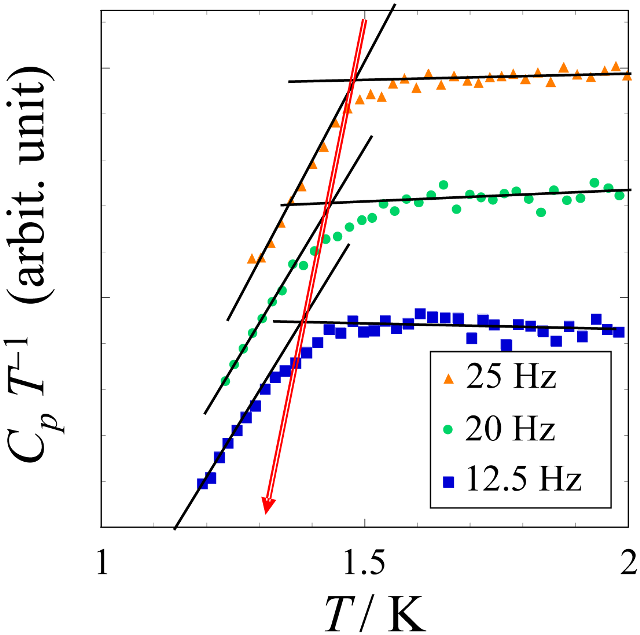
around 0.1 T. The measurements of frequency dependence by the ac-calorimetry
technique demonstrate that the freezing temperature tends to increase with the
increase of modulation frequency. The observed frequency dependence data
as well as a preliminary pressure dependence experimets are consistent with
the glass-like freezing typically observed in single-molecule magnets.
(by O. Kubota & Y. Nakazawa)
|
Fig. 1.
Low-temperature heat capacity of
[Mn4(hmp)4(pdm)2{N(CN)2}2] (ClO4)2 · 1.75H2O · 2Me(CN)
obtained by a dilution refrigerator. A thermal anomaly which is
associated with formation of an antiferromagnetic ordering
was observed at 380 mK.
|
|
Fig. 2.
Frequency dependence of the ac heat capacity obtained under external field
of 0.2 T. A systematic increase of the freezing temperature with
the increase of the ac frequency is observable from the figure.
|
Copyright © Research Center for Structural Thermodynamics,
Graduate School of Science, Osaka University. All rights reserved.