Research 4
Heat Capacities and Phase Transitions of the Quasi-One-Dimensional Nickel(III) Complexes [RBzPy][NiIII(mnt)2] (R = F, Cl, Br, I, NO2, CN)
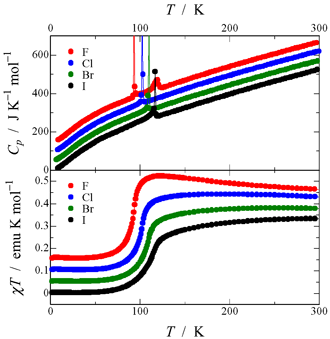
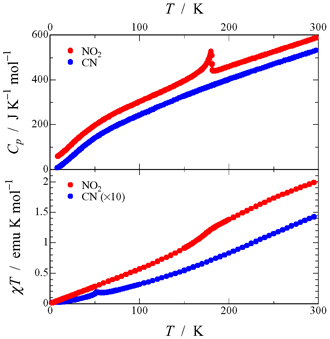
Heat capacities and magnetic susceptibilities of the quasi-one-dimensinal nickel(III) complexes [RBzPy][NiIII(mnt)2] (R = F, Cl, Br, I, NO2, CN) were measured. First-order phase transitions corresponding to the structural change due to dimerization of the [Ni(mnt)2]—ions, which accompanied depression of the magnetic susceptibility, were found at 93.3 K, 102.4 K, 109.8 K, 116.8 K, and 180.2 K for the F-, Cl-, Br-, I-, and NO2-substituted complexes, respectively. On the other hands, the CN-substituted complex indicated a magnetic anomaly due to an antiferrmagnetic phase transition at 52 K, where no thermal anomaly found. An unexpected first-order phase transition was found at 119.4 K in the F-substituted complex. Enthalpy and entropy changes due to the first-order phase transitions for the F-, Cl-, Br-, I-, and NO2-substituted complexes were determined to be 778 J mol-1 and 7.54 J K-1 mol-1 for the F-substituted complex, 586 J mol-1 and 5.75 J K-1 mol-1 for the Cl-substituted complex, 608 J mol-1 and 5.61 J K-1 mol-1 for the Br-substituted complex, 635 J mol-1 and 6.16 J K-1 mol-1 for the I-substituted complex, 1.04 kJ mol-1 and 6.20 J K-1 mol-1 for the NO2-substituted complex, respectively. The entropy gains agree with the expected value Rln2 (= 5.76 J K-1 mol-1) for S = 1/2 spin systems for the Cl-, Br-, I-, and NO2-substituted complexes, but higher value for the F-substituted complex. Since these complexes undergo structural phase changes accompanying magnetic changes by dimerization of the [Ni(mnt)2]—ions, the higher phase transition without magnetic change in the F-substituted complex would arise from a structural change keeping the Ni-Ni intervals equal.
(by X.-Z. Lan &Y. Miyazaki)
|
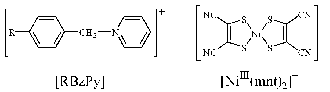
Fig. 1. Structures of [RBzPy]+ and [NiIII(mnt)2]— ions.
|
|
Fig. 2. Heat capacities (upper) and magnetic susceptibilities (lower) of [RBzPy][NiIII(mnt)2] (R = F, Cl, Br, I). For the sake of clarity, the heat capacities and magnetic susceptibilities except for the I-substituted complex are shifted upwards.
|
|
Fig. 3. Heat capacities (upper) and magnetic susceptibilities (lower) of [RBzPy][NiIII(mnt)2] (R = NO2, CN). For the sake of clarity, the heat capacity of the NO2-substituted complex is shifted upwards.
|
Copyright © Research Center for Structural Thermodynamics,
Graduate School of Science, Osaka University. All rights reserved.