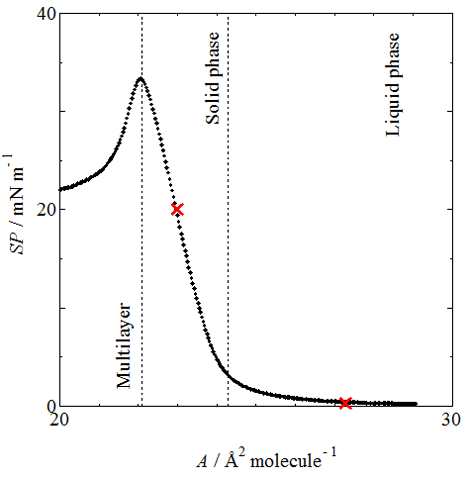
 Fig. 1. Surface pressure versus area isotherms of Langmuir films of 25DYol on water subphase. Two cross marks indicate the points where the surface pressure is 20 mN/m and 0.3 mN/m.
Monolayers of 10,12-pentacosadiyn-1-ol (25DYol) physisorbed on HOPG obtained by Langmuir-Blodgett method were investigated by STM. When the HOPG was dipped across the Langmuir film (L-film) on the aqueous subphase at 0.3 mN/m (liquid phase), the herringbone structure was obtained on HOPG surface. On the other hand, the parallel structure was obtained when the surface pressure was at 20 mN/m (solid phase) although the herringbone structure is more stable than the parallel one. We consider that the parallel structure is obtained because the molecular reorientation in the L-film (the solid phase) is prevented due to the high density molecular packing. Further, we demonstrated that the polymerization was tuned on the parallel molecular arrangement so that the polydiacetylen (PDA) wire was created efficiently by irradiation on the UV light. In contrast, the PDA wire was not created on the herringbone molecular arrangement. This dependence of the polymerization reactivity on the molecular arrangement can be discussed by the geometry between possibly reaction acetylenic carbon atoms.
Fig. 1. Surface pressure versus area isotherms of Langmuir films of 25DYol on water subphase. Two cross marks indicate the points where the surface pressure is 20 mN/m and 0.3 mN/m.
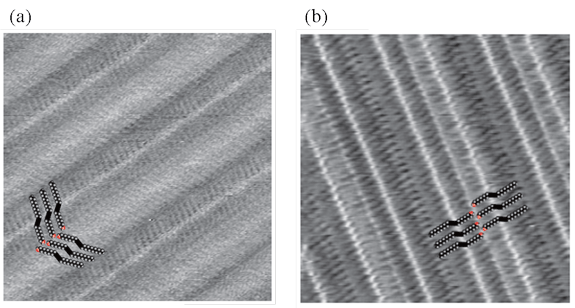 Fig. 2. STM images (19.6 nm × 19.6 nm) of monolayer of 25DYol physisorbed on graphite. The monolayer was obtained by LB method with surface pressure at (a) 0.3 mN/m and (b) 20 mN/m. The schematic overlay shows how the molecules are ordered on the surface.