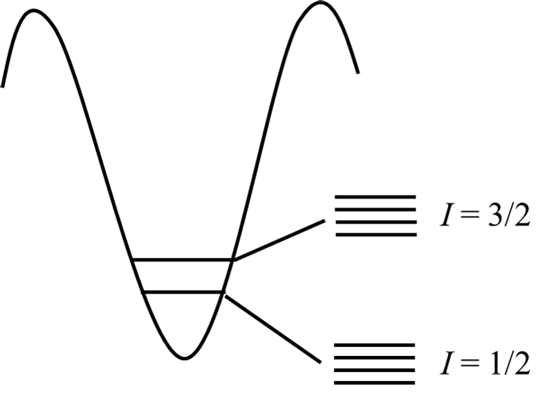
Fig. 1. A potential curve hindering a rotation of CH3 group and its level splitting. I is the total nuclear spin quantum number of three protons.
Thermodynamic properties of quantum tunneling in CH3 group are discussed in a metal complex [Cu(acac)(OCH3)]2 at low temperature and under magnetic field up to 14 T. We intend to investigate the character of quantum tunneling behavior in relevant to nuclear spin dynamics. We have observed that Schottkey heat capacity due to CH3 tunneling is reduced drastically by magnetic fields. Then, we analyzed relaxation curves of relaxation calorimetry in each magnetic field. As a result, we understood that the relaxation time of quantum tunneling was slower than the time scale of spin-lattice relaxation behavior. We speculated that the relaxation time in spin inversion process of protons becomes longer than the time scale of relaxation calorimetry in this low temperature region.
Fig. 1. A potential curve hindering a rotation of CH3 group and its level splitting. I is the total nuclear spin quantum number of three protons.
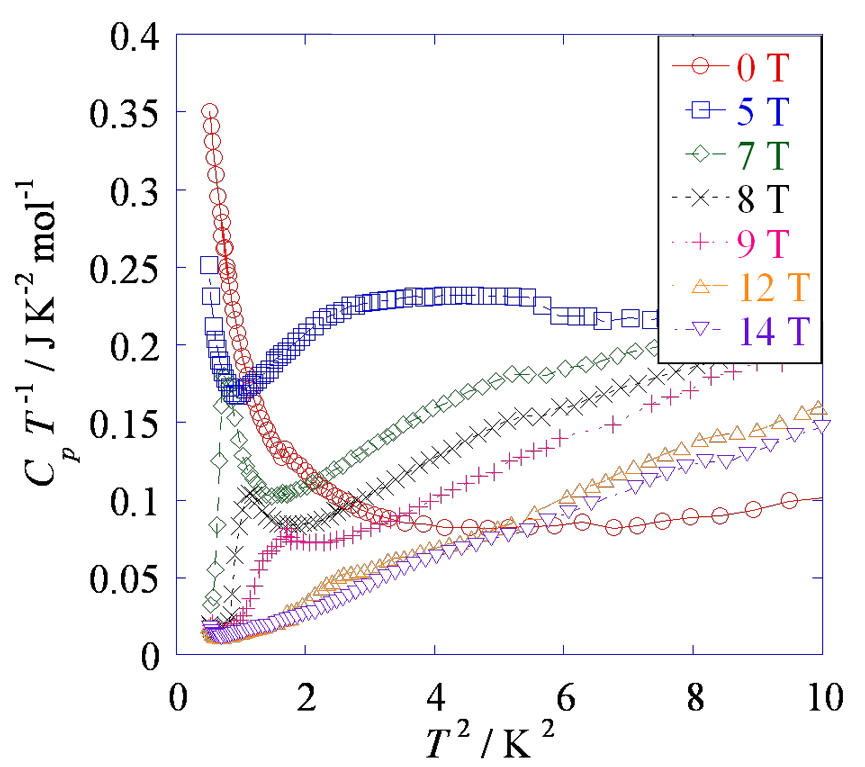
Fig. 2. Temperature dependence of the heat capacity of [Cu(acac)(OCH3)]2 shown as CpT -1 vs T2 plot under different magnetic fields.
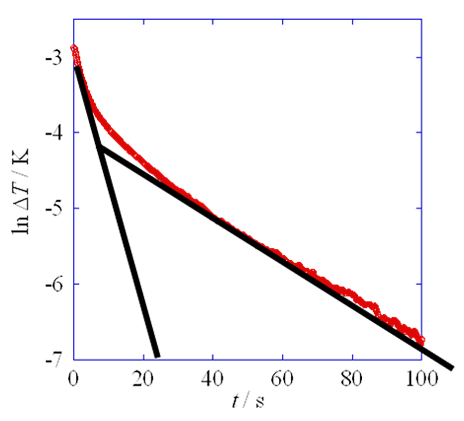
Fig. 3. lnΔT vs. t plot at 0.9 K under 7 T. The data suggested that the relaxation time of quantum tunneling was slower than spin-lattice relaxation time.