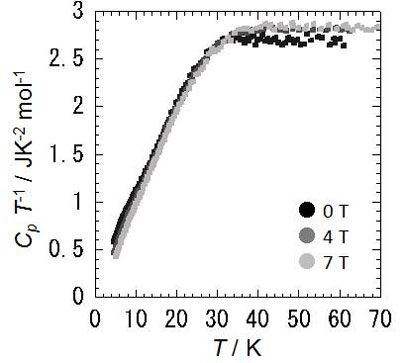
Fig. 1. Temperature dependence of heat capacity of K2Mn[Mn(CN)6] synthesized from H2O. The data were obtained under 0 T, 4 T, and 7 T. The peak temperature shifts to higher temperature side with increasing magnetic field.
Typical prussian blue analogous compounds have face centered cubic structure. However, in K2MnII[MnII(CN)6] and Rb2MnII[MnII(CN)6], low-spin MnII and high-spin MnII are bridged by cyanides and form 3-D zigzag framework structure. We measured heat capacities of K2MnII[MnII(CN)6] under 0 T, 4 T and 7 T by a relaxation calorimeter. This compound was synthesized from aqueous or non-aqueous solution. The samples prepared from H2O and CH3OH show different thermodynamic behavior especially in the absolute values of Cp. Broad humps of heat capacities were observed around 32.0 K under 0 T. The peak temperature shifts to higher temperature side with increasing magnetic field, which can be explained as a typical behavior of ferrimagnetic transition.
Fig. 1. Temperature dependence of heat capacity of K2Mn[Mn(CN)6] synthesized from H2O. The data were obtained under 0 T, 4 T, and 7 T. The peak temperature shifts to higher temperature side with increasing magnetic field.
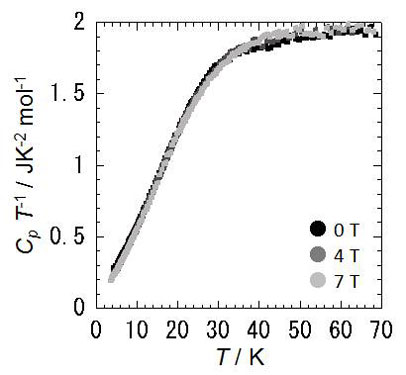
Fig. 2. Temperature dependence of heat capacity of K2Mn[Mn(CN)6] synthesized from MeOH. The magnetic field dependence of heat capacity resembles to that synthesized from H2O, although the absolute values of Cp are different.