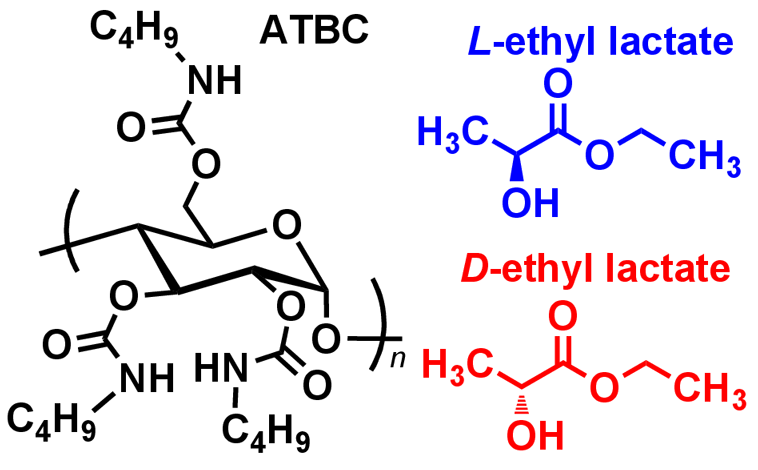
Chart. 1. Chemical structures of 1: amylose tris(n-butylcarbamate) (ATBC), 2: L-ethyl lactate (L-EL), 3: D-ethyl lactate (D-EL).
The radius of gyration for amylose tris(n-butylcarbamate) (ATBC) was determined in D-, DL-, and L-ethyl lactates at 25 °C by light and small-angle X-ray scattering as functions of the molecular weight in a range from 1.7 × 10⁴ to 1.7 × 10⁶ to investigate the chiral solvent dependence of the helical conformation of the amylose derivative. The analysis by the wormlike chain model showed that the chain stiffness parameter in D-EL was 52 % larger than that in L-EL, which is an unmistakable chiral solvent effect to the helical conformation of the amylose derivative. The content of intramolecularly hydrogen bonding C=O groups in D-EL was estimated to be 15 % more than that in L-EL, which was confirmed by heats of dilution for EL solutions of ATBC estimated by isothermal titration calorimetry.
Chart. 1. Chemical structures of 1: amylose tris(n-butylcarbamate) (ATBC), 2: L-ethyl lactate (L-EL), 3: D-ethyl lactate (D-EL).
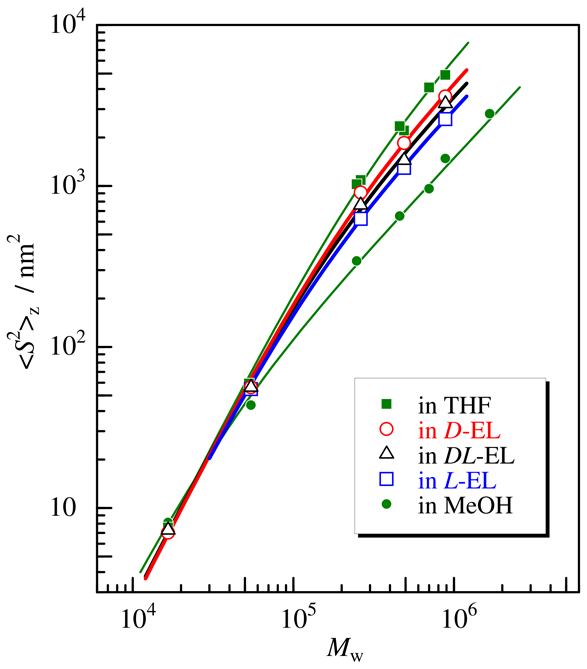
Fig. 1. Molecular weight dependence of 〈S 2〉z for ATBC in D-EL (open circles), DL-EL (triangles), L-EL (open squares), THF (filled squares), and MeOH (filled circles) at 25 °C. Curves: theoretical values calculated for the wormlike chain model.
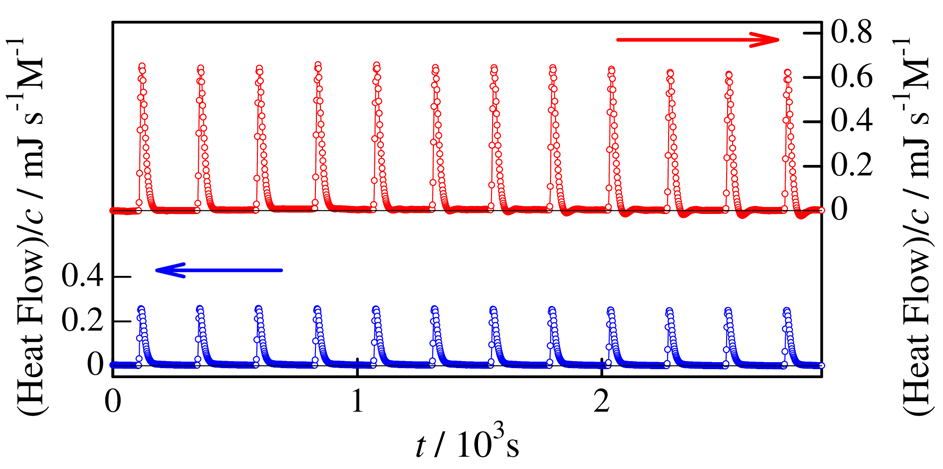
Fig. 2. Isothermal titration calorimetric data for ATBC in L-EL (top) and D-EL (bottom) at 25 °C. 2 µL solution was dropped at every 2 min.