Research on Greening Desert Soils and Elucidation of Iron Acquisition Mechanisms in Plants
Next-Generation Fertilizer: Muginec Acid
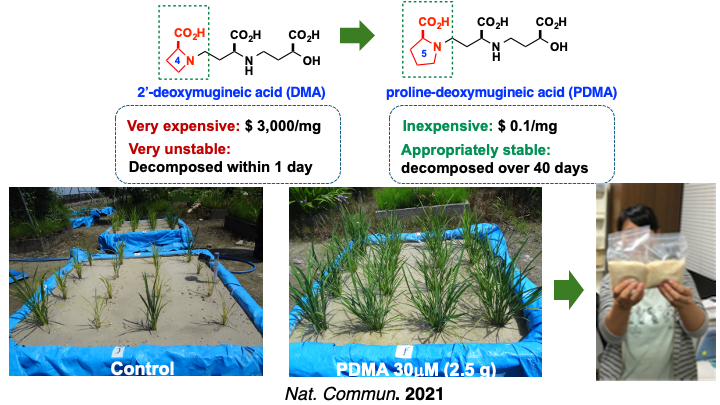
Barren soils, which are unsuitable for agriculture, cover 67% of the world's land, and half of which is constituted by alkaline desert soil. In these soils, iron becomes insoluble in water, preventing plants from absorbing it through their roots. This causes the plants to wither and die. Barley, a Poaceae plant species, addresses this problem by secreting a chelating agent called mugineic acid through its roots. Mugineic acid forms a 1 : 1 complex with the iron ions, dissolving them. The mugineic acid-iron complex is then taken up into the cell through a specific transporter on the roots. Thus, barley is a relatively stronger plant in alkaline soils. However, not all Poaceae plant have similar ability to tolerate in alkaline soils. For example, rice and maize, even in the same Poaceae plant family, cannot grow in alkaline soils due to their low ability to secrete mugineic acid derivatives. Therefore, we hypothesized that supplying mugineic acid as fertilizer could enable rice and maize cultivation in desert soils. However, mugineic acid is expensive and decomposes rapidly in soil, which makes it impractical to use as fertilizer. Thus, we developed proline deoxy-mugine acid (PDMA), a more stable and inexpensive mugineic acid derivative. We demonstrated that applying PDMA enables rice harvests in desert soils. We are currently advancing the practical application of this technology. It is expected to help solve the global food shortage problem and create a world free from hunger.
In addition to these practical applications, we are advancing academic research to clarify how plants and animals absorb and utilize iron ions.
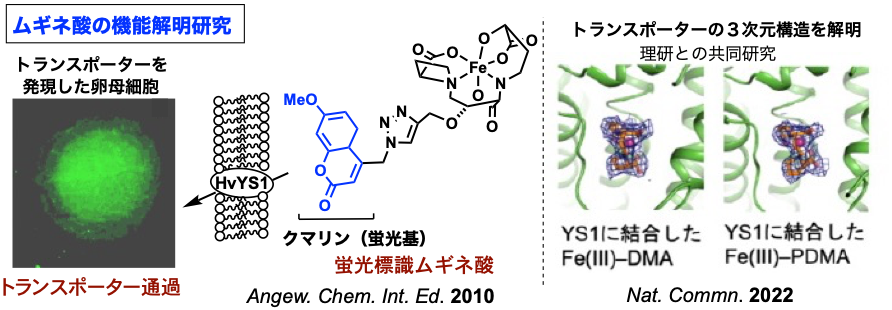
To date, we have developed a technique for fluorescently labeling mugineic acid and have successfully elucidated its behavior within plants. Through collaborative research, we recently succeeded in elucidating the three-dimensional structure of the transporter that incorporates mugineic acid-iron complexes.
Using mugineic acid derivatives, we plan to elucidate the iron ion uptake mechanism in mammals at the molecular level and develop applications such as treatments for plant diseases.