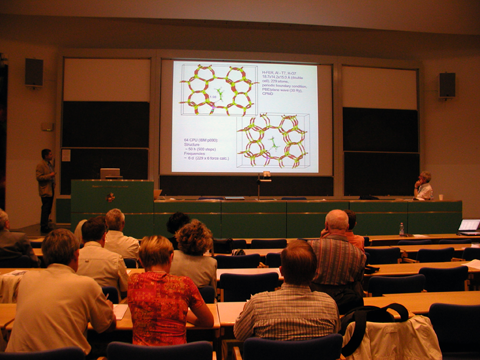
 A conference photo taken at Roskilde University. September, 2005
This international conference was held in Roskilde, Denmark, from 30 August to 3 September 2005. It was preceded by Hydrogen Bonding and Hydrogen Transfer, a graduate school, held in the same place on 29-30. Roskilde is a historical city of Denmark about 30 minutes by train to the west of Copenhagen. This conference was the 16th of a series of conference on the specialized topics of hydrogen bonding. The first one was held in 1977 in Karpacz, Poland. The origin of the conference may be traced further back to 1957 when an IUPAC conference on hydrogen bonds was held in Ljubljana, Slovenia. The 16th conference was organized by Professor P. E. Hansen with the help from Roskilde University, Department of Life Science and Chemistry, Danish Chemical Society and Danish Research Council for Nature and Universe. There were 130 participants from 21 countries.
The program consisted of seven sessions dealing with various aspects of hydrogen bonds: molecular structures, spectroscopic properties, isolated hydrogen bonded molecules, clusters, liquids and solids, surface hydrogen bonds, biological systems, hydrogen bonds in excited states. quantum chemical methods, molecular dynamics research and others. There were fifteen invited lectures and twenty-four oral and eighty-eight posters contributions.
Some of the topics presented were as follows. Properties and structures of simple hydrogen bonded systems like water, alcohols, amines and acids were discussed as studied by infrared, Raman and NMR spectroscopies, X-ray and neutron diffraction, ab initio quantum chemical calculation, Car-Parrinello MD and Monte Carlo simulations. In MD calculations, normal modes of vibrations were represented by animation in several presentations. Among biological molecules studied are aquoporin, a membrane protein believed to be responsible for transportation of water through cell membranes (P. Agre) and carboxylate dehydrogenase (D. Silverman). Importance of hydrogen bonds in biological substances had been pointed out in 1957 in the above mentioned IUPAC conference in Ljubljana. We are witnessing an actual development of what was foreseen 50 years ago. Hydrogen bonds are involved in the catalytic functions of zeolites and clays. These large systems were also discussed experimentally as well as theoretically (P. Ugliegno). Water, the most familiar hydrogen bonded substance, was also discussed. Odelius questioned our view that the majority of the molecules are engaged in hydrogen bonds in liquid water from his new spectroscopic experiment on core level electronic states of the oxygen. This elicited a lot of reactions, mostly of counter opinions. The discussion was not conclusive but it was stimulating to listen to a younger scientist with a new methods looking into what most of us regard well-established from a new point of view.
In the field of short hydrogen bonds to which our paper belonged, the following subjects were discussed: the nuclear quadrupole coupling constant of deuteron in short hydrogen bonds in solids (G.S. Harbisonj), infrared absorption continuum and transmission windows (J. Stare), quantum entanglement and neutron scattering in potassium hydrogen carbonate (F. Fillaux), phase transitions in deuteroxyphenalenone (A.A. Levin) and deuteration-induced phase transition in chromous acid (Matsuo et al.).
The conference started at 9 o'clock in the morning ended at nine o'clock in the evening. On the first day, the registration was started in the evening, followed by the welcome-to-Roskilde reception and two lectures. So the conference occupied more than four full days, giving a sufficient time for discussion to all of the contributions and invited lectures. One of the most important and delightful parts of an international conference is to meet old friends and to get acquainted with new ones, all based on common scientific interest. In this conference, I presented infrared spectra as a means of detecting a phase transition and left various shifts, splitting and intensities of peaks untouched, in part from the lack of my spectroscopic knowledge. After the session, Mark Rozenberg and Henryk Ratajczak were kind to tell me the essential points in the interpretation of the spectra such as the Fermi resonance, the Evans windows and intensity ratio of different modes. These were the most important moments of the conference. Discussions with Fillaux, Bellisent-Funel, Odelius and Levin were also enlightening. The older generation in the hydrogen bond research was represented by Professors Sandorfy, Olovsson and Sobczyk among other people who has contributed to this series of conference since the very beginning.
As those who have traveled in Scandinavian countries recently will agree, hotels in these countries are expensive. In Copenhagen where the 200th anniversary of H.C. Andersen's birthday is being celebrated, they are especially steep even on the ‘other side’ of the railway station. So we stayed at a B & B in Roskilde for one fifth of the price in Copenhagen. It was called a B & B but was actually without breakfast. We prepared our breakfast for ourselves. We enjoyed this life for a week, buying things at a nearby Fotex Supermarket. The other guest at the B & B was a family from Australia. We live really in the internet society: a small inn in a small Danish town receives guests from Australia and Japan.
Roskilde University was established in 1970 and, as is usual with new universities, is situated far away from the city center where most of the participants stayed. It was really helpful that two micro-bus driven by the university students picked us up at various places where we stayed, and carried us to the university. In the evening at nine, ‘the bus is leaving’ was a call to stop discussion and go home. All the participants enjoyed this at-home atmosphere of the conference. We left Roskilde thankful to Professor Hansen and his group for this nice conference.
A conference photo taken at Roskilde University. September, 2005