Structure and Phase Transition
in the Monolayer of n-C8F18
Adsorbed on Graphite
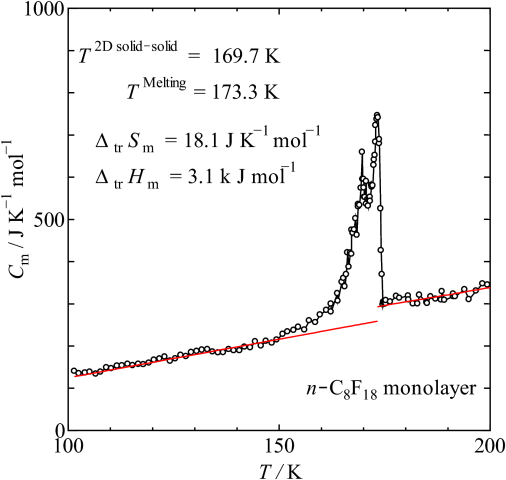
Heat capacity measurements have been performed for the monolayer of
n-C8F18 adsorbed on graphite between 100 K
and 200 K by adiabatic calorimetry to investigate a possible
phase transition in the 2D solid as well as the 2D melting transition.
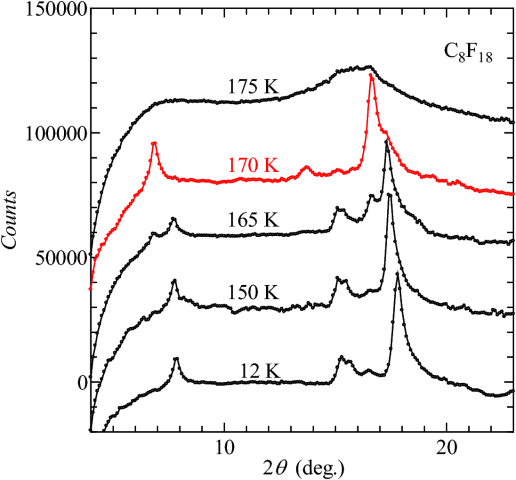
The X-ray diffraction measurements were also made in the temperature range
from 12 K to 190 K. The monolayer exhibits a phase transition
at 169.7 K, just below the melting point of 173.3 K.
The associated entropy for both anomalies is estimated to be 18
J K−1 mol−1.
(by K. Shimada & A. Inaba)
|
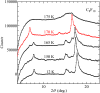
X-ray diffraction patterns obtained for the n-C8F18 monolayer on graphite,
showing that there is a 2D solid-solid phase transition
between 165 K and 170 K and a 2D melting between 170 K and 175 K.
|
|
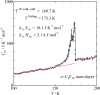
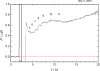
Molar heat capacity of the n-C8F18 monolayer on graphite.
Since the 2D solid-solid transition at 169.7 K and
the 2D melting at 173.3 K are close to each other,
the enthalpy and entropy change are estimated for both together.
|
Splitting Cells Are Hot
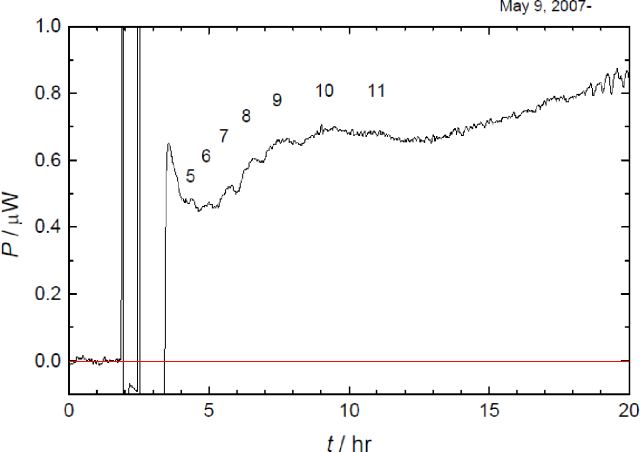
Thermogenesis of fertilized eggs of the starfish, Asterina
Pectinifera, was measured by isothermal microcalorimetry at
T = 295 K. A variation of thermogenesis was attributed
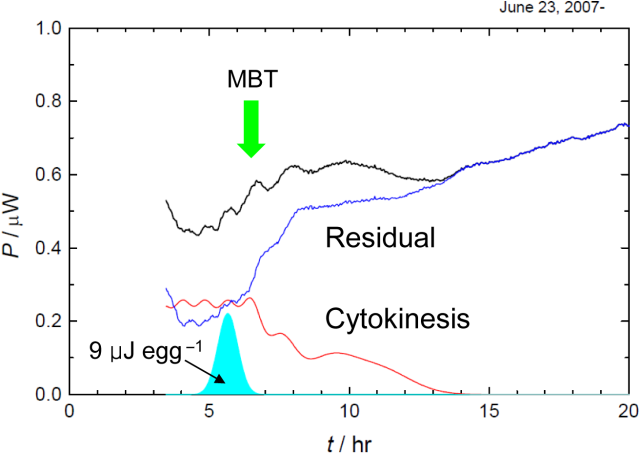
to synchronized cytokineses in the cleavage period. The heat of cytokinesis
was evaluated to be ca. 9 μJ embryo−1. Residual thermal dissipation showed an onset in
the vicinity of the 28 cell stage,
in which mid-blastula transition takes place.
(by Y. Nagano & H. Shirai)
|
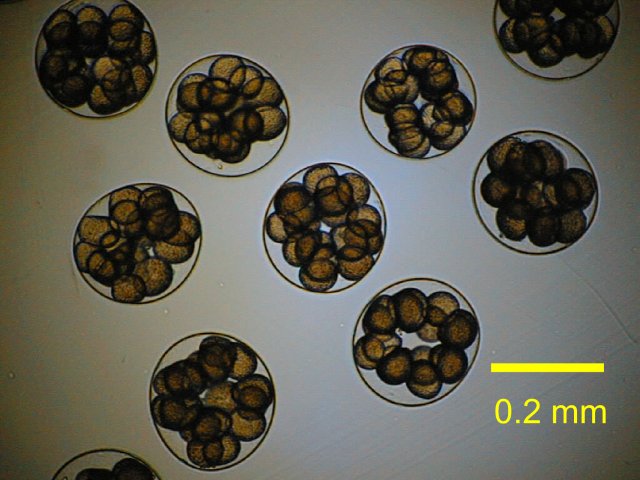
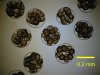
Photo 1. Embryos of Aterina Pectinifera in the
24 cell stage.
|
|
Fig. 1. Thermogenesis of the eggs. Matured eggs were fertilized at t = 0, and 87 eggs were loaded in the microcalorimeter at
t = 3 hr. Sequential peaks were attributed
to the fifth to the eleventh cleavage.
|
|
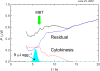
Fig. 2. Heat of cytokinesis was tentatively separated. The residual shows an onset
in the vicinity of the 28 cell stage, in which
mid blastula transition (MBT) takes places.
|
Copyright © Research Center for Structural Thermodynamics,
Graduate School of Science, Osaka University. All rights reserved.