Heat Capacity and Magnetic Phase Transition of the Molecule-Based Magnet
DOT• + · GaIII Cl4−
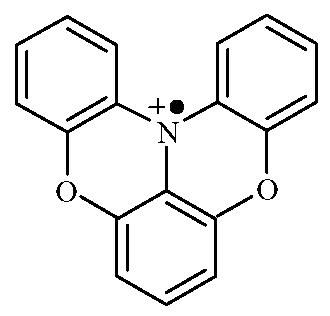
Heat capacities of 2,2′:6′,2″-dioxytriphenylamine
radical cation
DOT• + (S = 1/2)
and non-magnetic
GaIII Cl4− salt
DOT• + · GaIII Cl4−
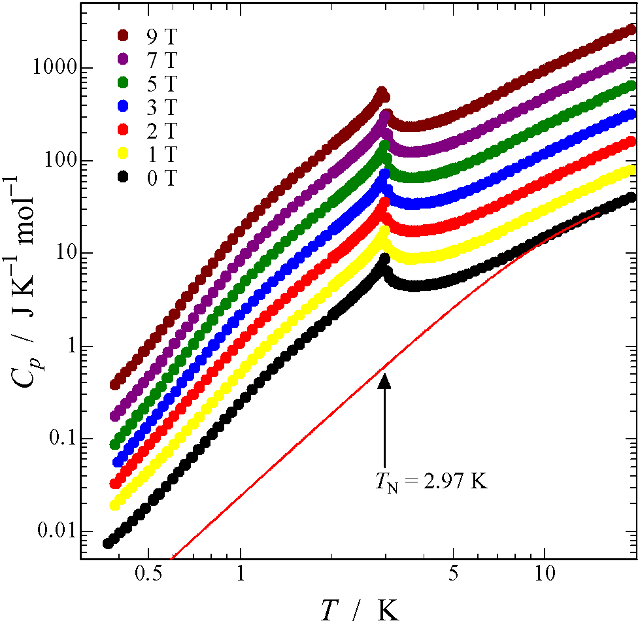
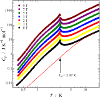
were measured by relaxation method under magnetic fields. A heat capacity peak
was observed at 2.97 K. This peak is due to antiferromagnetic phase transition
from the magnetic field dependence of the peak temperature. The estimated
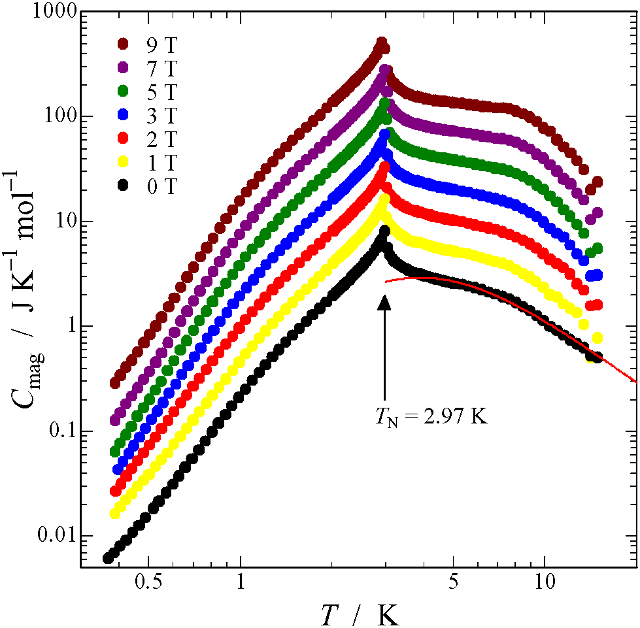
magnetic entropy 5.80
J K−1 mol−1
is close to Rln2 (= 5.76
J K−1 mol−1) for S = 1/2
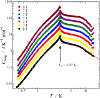
spin systems. The zero-field magnetic heat capacity above the magnetic phase
transition temperature is expressed well by the theoretical heat capacity curve
for the high-temperature expansion of an S = 1/2
one-dimensional antiferromagnetic Heisenberg model
with the intrachain magnetic interaction
J/kB
= −4.1 K. From the mean-field approximation by use of the derived
intrachain magnetic interaction and the magnetic phase transition temperature,
the interchain magnetic interaction was estimated to be
|zJ′/kB|
≈ 8.7 K.
(by X.-Z. Lan & Y. Miyazaki)
|
Fig. 1.
Molecular structure of DOT• +.
|
|
Fig. 2.
Heat capacities of
DOT• + · Ga Cl4−
under magnetic fields. Solid curve indicates the lattice heat capacity.
For the sake of clarity, the heat capacities except for the zero-field
heat capacity are shifted upwards.
|
|
Fig. 3.
Magnetic heat capacities of
DOT• + · Ga Cl4−
under magnetic fields. For the sake of clarity, the magnetic heat capacities
except for the zero-field magnetic heat capacity are shifted upwards.
Solid curve indicates the theoretical heat capacity for high-temperature
expansion of S = 1/2 one-dimensional
antiferromagnetic Heisenberg model with
J/kB
= −4.1 K.
|
Copyright © Research Center for Structural Thermodynamics,
Graduate School of Science, Osaka University. All rights reserved.