Heat Capacity and Magnetic Phase Transition of the Molecule-Based Magnet
TOT• + · FeIII Br4−
Heat capacities of
2,2′:6′,2″:6″,6-trioxytriphenylamine radical cation
TOT• + (S = 1/2) and
FeIII Br4− (S = 5/2) salt
TOT• + · FeIII Br4−
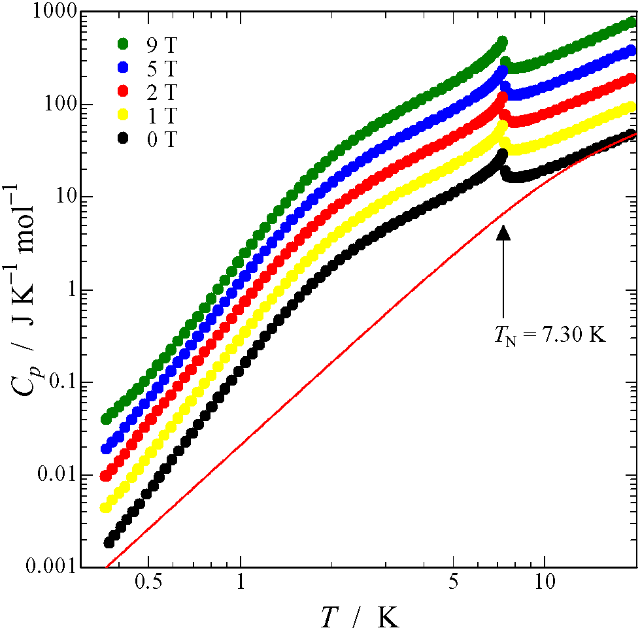
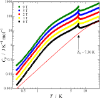
were measured by relaxation method under magnetic fields. A heat capacity peak
was observed at 7.30 K. This peak is due to antiferromagnetic phase transition
from the magnetic field dependence of the peak temperature. Magnetic entropy
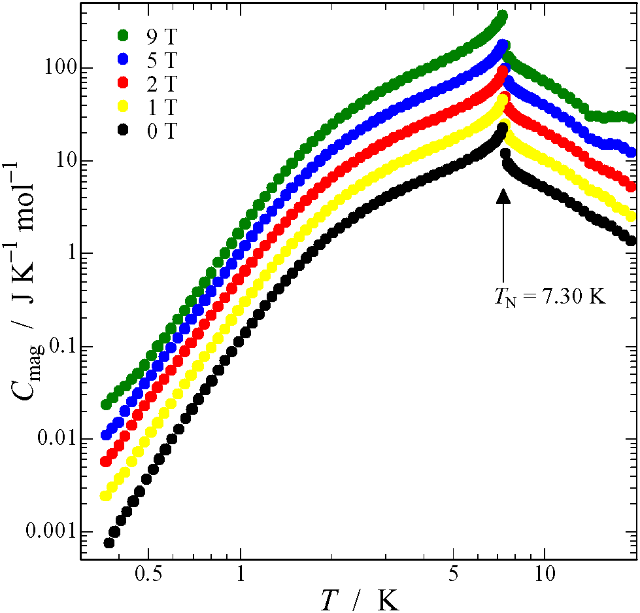
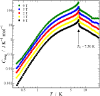
was evaluated to be 14.4
J K−1 mol−1, which is close to
Rln6 (= 14.9
J K−1 mol−1) for S = 5/2 spin systems.
From the ratio of the magnetic entropy above the magnetic phase transition
temperature to the whole magnetic entropy,
TOT• + · Fe Br4−
would have a three-dimensional body-centered cubic magnetic structure with
J/kB
= −0.39 K, which agrees roughly with the value
J/kB
= −0.16 K derived by the mean-field approximation
with the magnetic phase transition temperature. Magnetic interaction within the
Fe Br4− dimer was estimated to be
Jd/kB
= −1.1 K.
(by X.-Z. Lan & Y. Miyazaki)
|
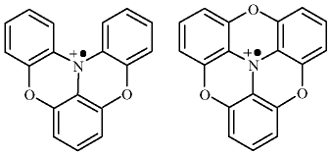
Fig. 1.
Molecular structures of DOT• + (left)
and TOT• + (right).
|
|
Fig. 2.
Heat capacities of
TOT• + · Fe Br4−
under magnetic fields. Solid curve indicates the lattice heat capacity.
For the sake of clarity, the heat capacities except for the zero-field
heat capacity are shifted upwards.
|
|
Fig. 3.
Magnetic heat capacities of
TOT• + · Fe Br4−
under magnetic fields. For the sake of clarity, the magnetic heat capacities
except for the zero-field magnetic heat capacity are shifted upwards.
|
Copyright © Research Center for Structural Thermodynamics,
Graduate School of Science, Osaka University. All rights reserved.