Low Temperature Heat Capacities
of Ices Crystallized from
Metastable Glycerol Aqueous Matrices
Solutions of glycerol and water of intermediate concentration – about
glycerol 50% or 60% (w/w) – vitrify homogenously if cooled fast enough.
On heating, however, water's crystallization tendency prevails and ice grows
at the expense of the water contents of the homogeneous glycerol aqueous
matrix. It must be noted, though, that ice formation stops well before a pure
glycerol phase is attained and, therefore, the two phases that remain in the
end are (i) a pure ice (water) phase and (ii) a glycerol-rich phase known as
the maximally freeze-concentrated solution, MFCS for
short. Water's spontaneous crystallization on heating takes place at
temperatures appreciably lower than the corresponding temperatures at the
equilibrium binary phase diagram and has been observed to lead to the formation
of a novel two-dimensionally ordered structure of ice
– 2D-Ice – as characterized through its neutron diffraction
patterns. We report here the results of a recent calorimetric characterization
of 2D-Ice and the MFCS obtained from a glycerol 55% (w/w) aqueous solution.
Measurements using an adiabatic calorimeter allowed us to evaluate the heat
capacity and concentration of the MFCS – evaluated to be glycerol 74.3%
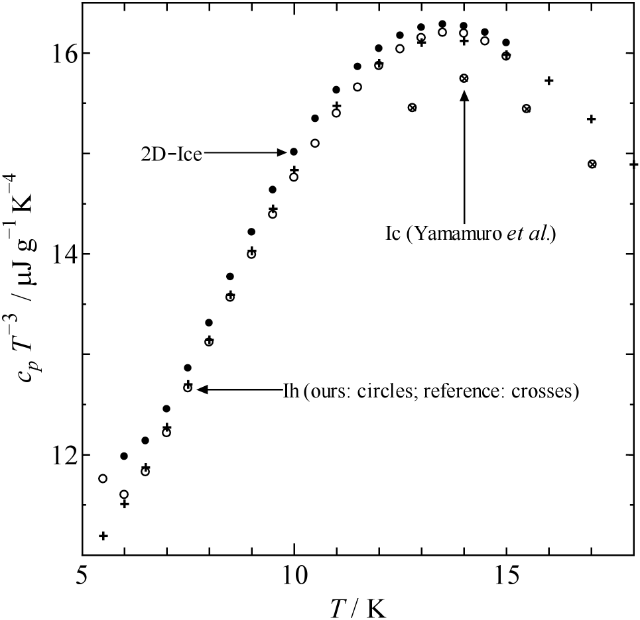
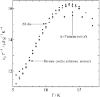
– and to establish that, on average, the heat capacity of 2D-Ice is 1.3%
larger than that of ordinary hexagonal (Ice Ih) between
T = 6 K and T = 15 K
(see Fig. 3).
(by O. Camacho & A. Inaba)
|
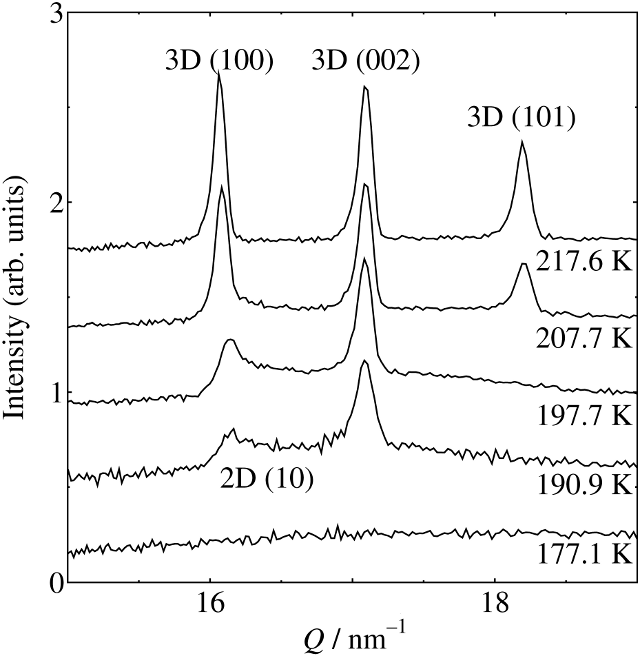
Fig. 1.
Neutron diffraction patterns of ices crystallized from a glycerol 55% (w/w)
aqueous (D2O) solution. A two-dimensionally ordered
structure of ice forms at 190 K and transforms into hexagonal ice at 220 K.
|
|
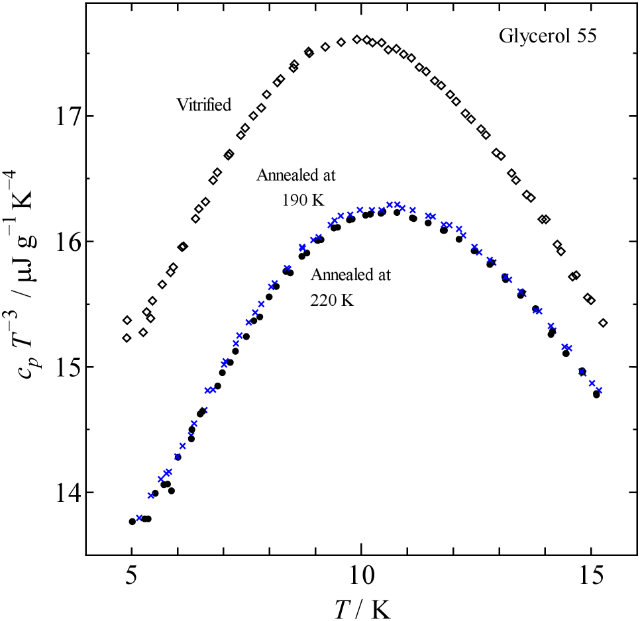
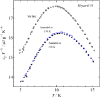
Fig. 2.
Heat capacity, plotted as
cp T−3
against T, of a sample of glycerol 55% (w/w)
after initial vitrification and subsequent annealing at
T = 190 K and T = 220 K.
|
|
Fig. 3.
Heat capacities, plotted as
cp T−3
against T, of the two-dimensionally ordered
structure of ice (2D-Ice), hexagonal ice (Ih) – ours: circles;
reference data (Smith et al.): crosses –
and cubic ice, as given by Yamamuro et al..
|
Copyright © Research Center for Structural Thermodynamics,
Graduate School of Science, Osaka University. All rights reserved.