Low-Temperature Thermal Conductivity
of Rubrene Single Crystals:
A Method to Estimate
Defect Density of Organic Crystals
We disclose a method of quantitatively characterizing crystalline defects by
measuring low-temperature thermal conductivity in relatively clean organic
molecular crystals, which is gaining increasing interest due to recent
industrial attentions to organic semiconductor crystals and nonlinear-optical
crystals. As the result of the measurement with representative organic
semiconductor crystals of rubrene, the “phonon peak” of the
conductivity in the temperature range of 10 ~ 20 K is indeed sensitive to the
amount of strain dislocations in the crystals around only
1015 cm−3,
demonstrating the usefulness of the present method.
(by Y. Okada & J. Takeya)
|
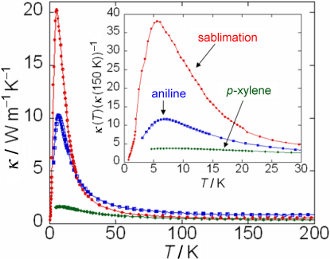
Fig. 1.
Temperature dependence of thermal conductivity of rubrene crystals grown by
three different conditions (red: from gas phase, blue: from aniline
solution, and green: from p-xylene solution).
|
|
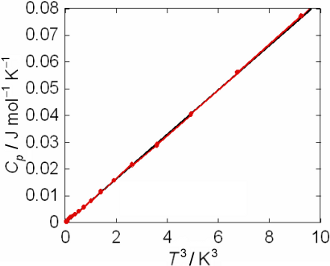
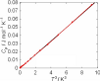
Fig. 2.
Low temperature heat capacity of a rubrene crystal.
|
|
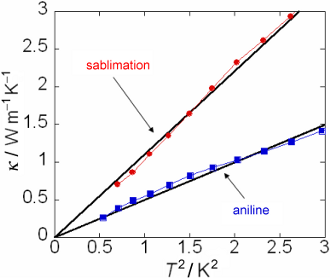
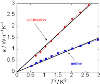
Fig. 3.
T2 vs
κ plot for the rubrene crystals
grown from gas phase and from aniline solution.
|
Copyright © Research Center for Structural Thermodynamics,
Graduate School of Science, Osaka University. All rights reserved.