Desorption of 1-Octadecanol Molecules
Maintaining the Hydrogen Bonds
at Liquid/Solid Interfaces

The form of 1-octadecanol molecules in desorbing from a highly ordered pyrolytic graphite (HOPG) surface at liquid/solid interface was investigated using scanning tunneling microscopy (STM). In a mixture solution of 1-octadecanol and 3-imino-4,5,6,7-tetrachloroisoindolin-1-one (ITCII), initially, a mono-molecular layer of 1-octadecanol was formed with many domains on HOPG but the 1-octadecanol layer was gradually replaced by ITCII molecules from the edges of the domains. Since the hydrogen bonds between the two columns at hydroxyl pairs were maintained, the 1-octadecanol columns disappeared in a unit of two columns.

(by D. Takajo)

Fig. 1

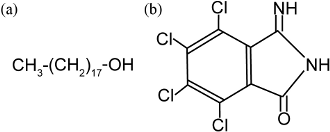
Fig. 1. Molecular structures of (a) 1-octadecanol and (b) ITCII.
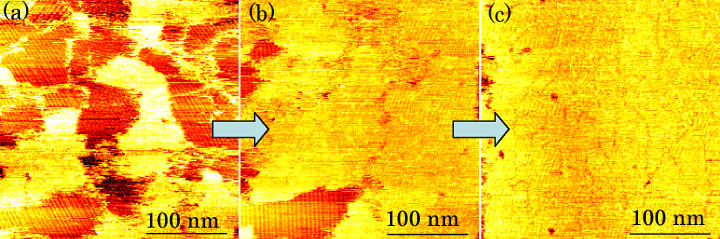
Fig. 2

Fig. 2. Successive STM images of 1-octadecanol and ITCII adsorbed on an HOPG surface at liquid/solid interface obtained 14, 15, and 17 min after dropping the mixture solution, respectively. (a) Coexistence of 1-octadecanol (darker contrast) and ITCII (brighter contrast) domains separately. (b) Replacement of 1-octadecanol domains by ITCII molecules from the edges of the domains. (c) Almost complete replacement by ITCII molecules.
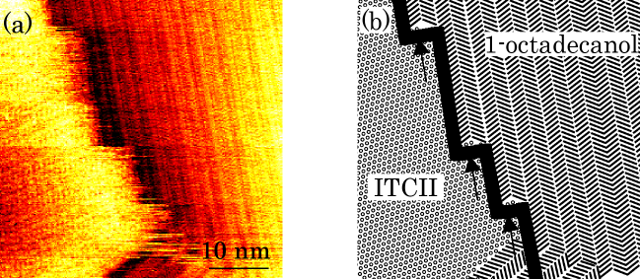
Fig. 3

Fig. 3. (a) High resolution STM image at 1-octadecanol/ITCII interface. (b) The explanation for (a) where bold sticks and circles represent 1-octadecanol and ITCII, respectively. The bold line emphasizes the step-like pattern at the interface. The width of steps indicated by arrows corresponds to the 1-octadecanol dimer length.

Copyright © Research Center for Structural Thermodynamics, Graduate School of Science, Osaka University. All rights reserved.