Research 17
Spin Frustration and Ground State of Volborthite
Thermodynamic investigations on volborthite [Cu3V2O7(OH)2·2H2O], which possesses a two-dimensional kagomé
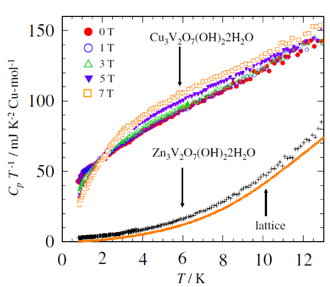
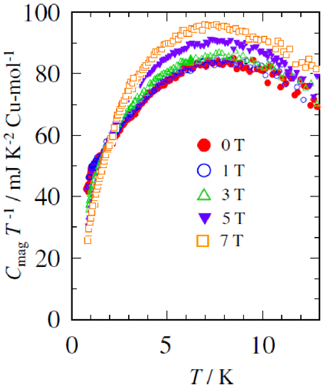
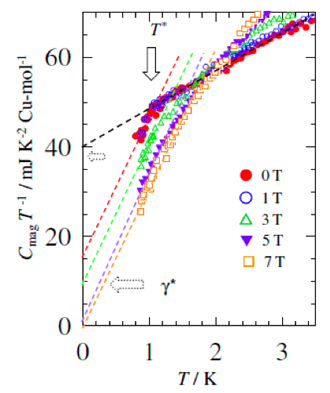
structure of S-1/2 spins, are presented. By the thermal relaxation technique, the low-temperature heat capacities of volborthite and its Zn analogue compound were measured between 0.8 and 45 K. Belo 3.5 K, the magnetic heat capacity of volborthite is characterized by two contributions of T-linear and T2 dependences, the former of which is large above 1 K. This fact gives an evidence of dense gapless excitations. We find a distinct kink in CpT-1 at 1 K, which demonstrates a thermodynamic phase transition of short-range nature to a novel ground state as reported in NMR experiments performed by ISSP group. The T-linear term becomes smaller but remains finite even in the low-temperature state below 1 K, while it is gradually reduced with increasing magnetic field and vanishes at 5 T, which is close to the critical field for the field-induced transition observed in the first magnetization step.
(by T. Moriura & S. Yamashita & Y. Nakazawa)
|
Fig. 1. Temperature dependences of heat capacity divided by temperature for volborthite at magnetic fields between 0 and 7 T. The lattice heat capacity is estimated based on the data of Zn compound.
|
|
Fig. 2. Temperature dependences of magnetic heat capacity (Cmag) of volborthite. The broad hump structure characteristic of short-range fluctuations in Kagome lattice is observed.
|
|
Fig.3. Magnetic heat capacity of volborthite at low temperature around 1 K in a CmagT−1 vs T plot. The extrapolations of the data at H = 0 above and below 1 K down to T = 0 give the coefficients of the T–linear term in the magnetic heat capacity. The T–linear term disappears under magnetic fields above 5 T.
|
Copyright © Research Center for Structural Thermodynamics,
Graduate School of Science, Osaka University. All rights reserved.