Research 18
Heat Capacity Measurements of κ-[(BEDT-TTF)1-x(BEDSe-TTF)x]2 Cu[N(CN)2]Br
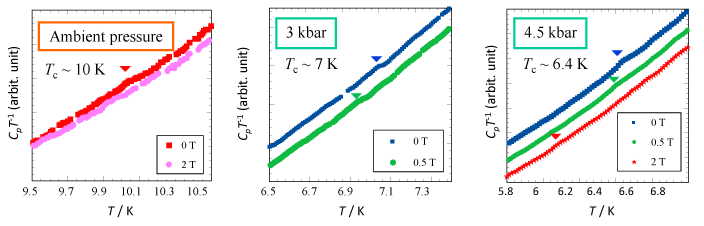
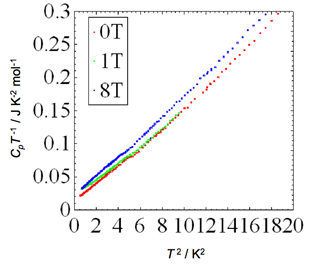
The mechanism and peculiar nature of 10 K class superconductor κ-(BEDT-TTF)2X system is still remains as open questions in condensed matter science. In order to clarify thermodynamic behavior of these organic superconductors, we are studying the behavior occurs by pressure in the typical phase diagram of the dimer-Mott system. It is well known that superconductor transition temperature (Tc) of κ-[(BEDT-TTF)1-x(BEDSe-TTF)x]2Cu[N(CN)2]Br shift to low-temperature with increase of x due to the increase of chemical pressure. We have performed ac heat capacity measurements for x = 0.05 and 0.1 samples and found that a systematic decrease of transition temperatures occurs with the increase of external pressure. In the low x region, the substitution certainly works as a chemical pressure. On the other hand, the relaxation calorimetry data of x = 0.17 show an anomalous enhancement of CpT-1 under 8 T, probably due to the antiferromagnetic fluctuations to make SDW-like ground state in higher x region.
(by Y.Horie & N. Tokoro & Y. Nakazawa)
|
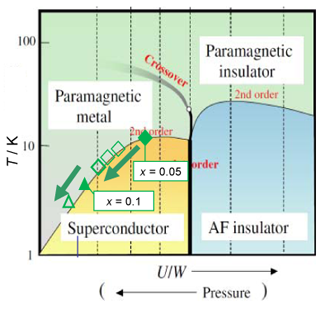
Fig. 1. The electronic phase diagram of the dimer–Mott type organic system. The high–Tc superconductive phase is neighboring to the Mott insulating phase.
The position of κ∼[(BEDT–TTF)1–x(BEDSe-TTF)x]2Cu[N(CN)2]Br (x = 0.05, 0.1) and their transition temperature under pressure are marked in the phase diagram.
|
|
Fig. 2. Temperature dependence of ac heat capacities ofκ∼[(BEDT–TTF)0.95(BEDSe–TTF)0.05]2Cu[N(CN)2]Br obtained under pressures. The decrease of the transition temperature is confirmed.
|
|
Fig. 3. Low temperature heat capacity of x = 0.17 sample obtained under 0 T, 1 T, and 8 T. The data of 8 T means that the ground state of this sample changes from simple metal to anomalous metallic state with strong magnetic fluctuations.
|
Copyright © Research Center for Structural Thermodynamics,
Graduate School of Science, Osaka University. All rights reserved.