Research 21
Heat Capacities of α-(BEDT-TTF)2MHg(SCN)4 (M = K, Rb)
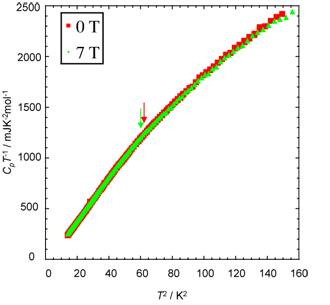
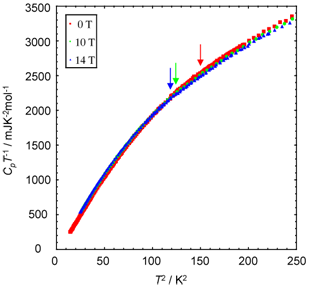
We have performed heat capacity measurements of low-dimensional organic conductors α-(BEDT-TTF)2MHg(SCN)4 (M = K, Rb), which show density-wave state around 8 and 12 K respectively. These transition temperatures shift to lower temperature side with increase of magnetic fields. It is well known that there exist quasi-one-dimensional and two-dimensional Fermi surfaces in α-(BEDT-TTF)2MHg(SCN)4 (M = K, Rb), both of which contribute to electronic heat capacity at low temperatures. The density-wave state is caused as a result of nesting of the quasi-one-dimensional portion of the Fermi surface. We have evaluated the absolute values of heat capacities by thermal relaxation method using tiny single crystals in this work and evaluated the absolute values of heat capacity jump around the transition temperatures. The magnitude of the CpT-1's of two salts are comparable with the difference of usual γ values of metallic systems and residual γ values reported previously. The disappearance of quasi-one dimensional Fermi surface by the density-wave formation was confirmed by the present thermodynamic experiments. We will measure heat capacities under pressures and with several magnetic fields by ac temperature modulation technique as a next step.
(by M. Danda & Y. Nakazawa)
|
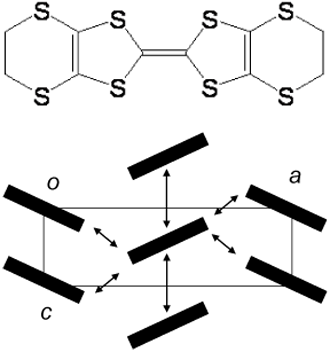
Fig. 1. Molecular structure of BEDT–TTF and structure of the donor sheet in α–(BEDT–TTF)2MHg(SCN)4, viewed along the molecular long axis.
|
|
Fig. 2. Cp T−1 vs T2 plot of α–(BEDT–TTF)2KHg(SCN)4. The thermal anomaly shifts to lower temperature with the increase of magnetic field.
|
|
Fig. 3. Cp T−1 vs T2 plot of α–(BEDT–TTF)2RbHg(SCN)4. The thermal anomaly shifts to lower temperatures with the increase of magnetic fields.
|
Copyright © Research Center for Structural Thermodynamics,
Graduate School of Science, Osaka University. All rights reserved.