Magnetic Properties of 2D-Network Magnetic System Consisting of
Mn4 Single-Molecule Magnet
The magnetic field dependence of heat capacities of 2D network
materials consisting of Mn4 single-molecule
magnets connected by
dicyanamide anions are studied between 0.6 K and 8 K. The
thermal
anomalies related to the formation of antiferromagnetic long-range
ordering of large spins (S=9) by the
superexhange coupling between
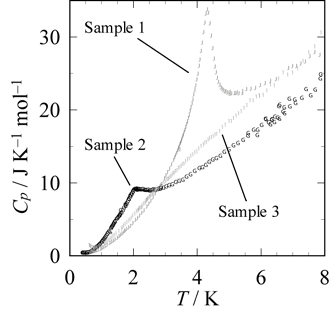
neighboring clusters are observed. However, the heat capacity peak is
drastically suppressed by applying weak magnetic field, especially
when the field is applied parallel to the 2D plane. In the case of
TN=2.1 K
material, magnetic order was found to be arisen by the ground
state doublet
of Sz=9,
Sz=–9
only, and the competitive picture between
bulk magnet and SMM gives rise to an intrinsic peak broadening effects
probably resembles to the finite-size effects in the magnetic
clusters.
(by Y. Nakazawa & T. Fujisaki)
|
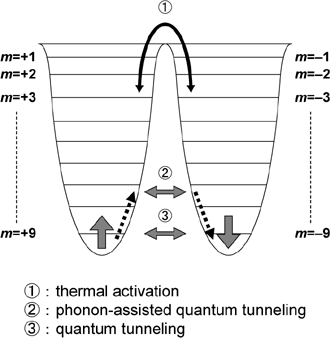
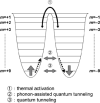
Fig. 1. Energy diagram of the
Mn4 cluster
complexes with S=9.
|
|
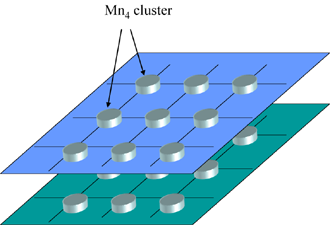
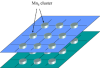
Fig. 2. 2D-network system consisting of single-molecule
magnets.
|
|
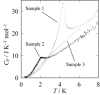
Fig. 3. Heat capacity of
(1)[Mn4(hmp)6{N(CN)2}2](ClO4)2,
(2)[Mn4(hmp)4Br2(OMe)2{N(CN)2}2]·2THF·0.5H2O,
(3)[Mn4(hmp)4(pdm)2{N(CN)2}2](ClO4)2·1.75H2O·2Me(CN).
|
|
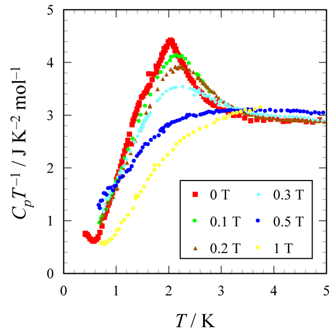
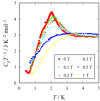
Fig. 4. CpT–1
vs. T plot for
[Mn4(hmp)4Br2(OMe)2{N(CN)2}2]·2THF·0.5H2O. The origin of the peak broadening is
considered as the blocking of spin-reversal observed in
single-molecule magnet.
|
Magnetic Phase Transition in the 1D Charge-Ordered Insulator of
(DI-DCNQI)2Ag
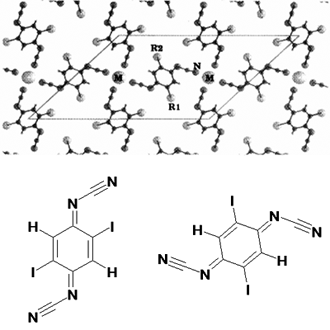
Heat capacity measurements of organic charge transfer salt consisting
of acceptor molecules of
(R1,R2-DCNQI)
(R1,R2=I) and monovalent metal
cation M=Ag are performed by the thermal relaxation technique. In this
salt, the formation of charge-ordered state due to nearest-neighbor
Coulomb repulsion is expected around 220 K. However the spin degree of
freedom survives down to low temperatures and behaves as a kind of
one-dimensional spin system. At about 5–6 K, it falls into an
antiferromagnetically ordered state. Our recent experimental analysis
of low-temperature heat capacity shows a clear peak structure around
6 K, which has magnetic-field dependence. The data obtained under
external fields up to 10 T applied both parallel and perpendicular to
the stacking direction revealed that the spin easy axis
is c-axis and
a spin-flop transition takes place between 1 T and 2 T when the
magnetic fields are applied parallel to this axis.
(by Y. Nakazawa & K. Okuma)
|
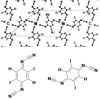
Fig. 1. Molecular structure of DI-DCNQI
(2,5-diiode-N,N'-dicyanoquinonediimine). In
(DI-DCNQI)2Ag crystal, DI-DCNQI
molecules they stack along the c-axis
and form a 1D-column structure in this direction. The 1/4-filled
LUMO band is established due to the electron transfer along this
direction.
|
|
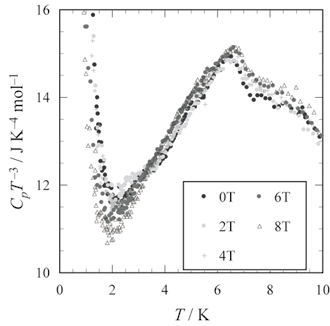
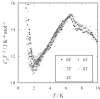
Fig. 2. Temperature dependence
of CpT–3 of
(DI-DCNQI)2Ag salt. The magnetic fields
are applied perpendicular to the stacking direction. The peak
temperature shift slightly to the upward direction with
increasing magnetic fields, but the transition itself survives
if we apply large magnetic fields of 8 T.
|
|
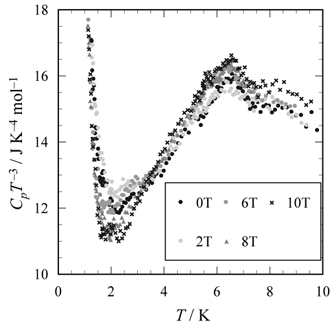
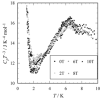
Fig. 3. Temperature dependence
of CpT–3 of
(DI-DCNQI)2Ag with the external fields
applied parallel to the c-axis. The
spin-flop fields are observed near 2 T, which is consistent
with the results of other experiments such as EPR and NMR.
|
Heat Capacity and Phase Transitions of the Two-Dimensional
Metal-Assembled Complex
NPe4[MnIIFeIII(ox)3]
Heat capacities of the two-dimensional metal-assembled complex
NPe4[MnIIFeIII(ox)3] (Pe=n-C5H11, ox = oxalato) were
measured by
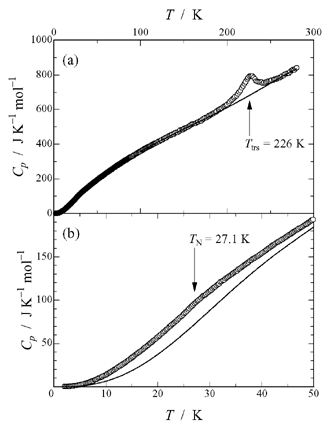
relaxation method. Two distinct heat capacity anomalies were detected
at TN=27.1 K and Ttrs=226 K, corresponding to antiferromagnetic
and structural phase transitions, respectively, along with a hump
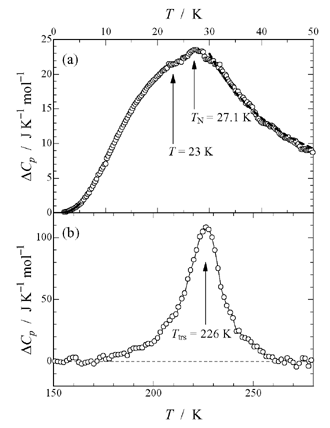
around 23 K. The transition enthalpies and entropies were determined
to be ΔH=1.11 kJ mol–1 and ΔS=33.2 J K–1 mol–1 for the magnetic
phase transition, and ΔH=2.90 kJ mol–1 and ΔS=13.1 J K–1 mol–1 for the structural phase transition. The
estimated transition entropy is
close to the expected magnetic entropy Rln(6×6)=29.8 J K–1 mol–1
for the spin multiplicity of high spin MnII and FeIII ions.
The magnetic
heat capacities above TN can be well represented by the
high-temperature expansion of S=5/2 two-dimensional
antiferromagnetic Heisenberg model of a honeycomb lattice with an
intralayer exchange interaction J/kB=–3.3 K. Application of
spin-wave theory indicated a three-dimensional antiferromagnet below
TN.
The hump around 23 K might be associated with the existing
uncompensated magnetic moments. The structural phase transition at
Ttrs=226 K may be assigned to a structural
phase transition of
order-disorder type due to increasing conformational change of the
n-C5H11 chains in the organic cation.
(by Y. Miyazaki)
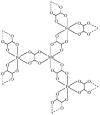
|
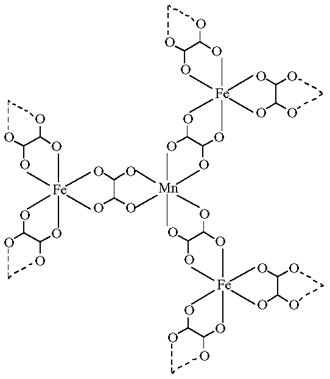
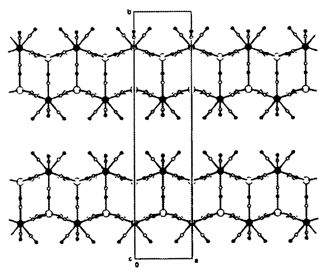
Fig. 1. [MnIIFeIII(ox)3]– network
structure.
|
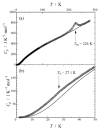
|
Fig. 2. Heat capacities of
NPe4[MnIIFeIII(ox)3] over the
whole temperature region (a) and at low temperatures
(b). Antiferromagnetic and structural phase transitions were
observed at TN=27.1 K and
Ttrs=226 K,
respecitively.
|
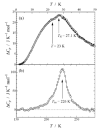
|
Fig. 3. Excess heat capacities at low (a) and high (b)
temperatures. Excess heat capacities
below TN=27.1 K are
proportional
to T3 (solid
curve), indicating three-dimensional antiferromagnet below
TN. Excess heat
capacities
above TN are
well represented by high-temperature expansion
of S=5/2 two-dimensional
antiferromagnetic Heisenberg model of a honeycomb lattice with
an intralayer exchange
interaction J/kB=–3.3 K
(broken curve).
|
Heat Capacity and Magnetic Phase Transition of the Two-Dimensional
Metal-Assembled Complex
(tetrenH5)0.8CuII4[WV(CN)8]4·7.2H2O
Heat capacities of the two-dimensional metal-assembled complex
(tetrenH5)0.8CuII4[WV(CN)8]4·7.2H2O
(tetren = tetraethylenepentamine)
were measured under magnetic field parallel
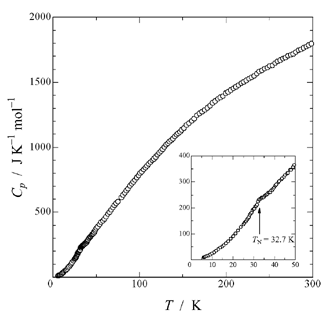
to b axis. A heat
capacity peak due to ferromagnetic phase transition was observed at
Tc=32.7 K under
zero magnetic field, together with a heat capacity tail
arising from the short-rang ordering of spins characteristic of
two-dimensional magnets above Tc. As magnetic field increased, both
the magnetic transition temperature and the magnetic heat capacities
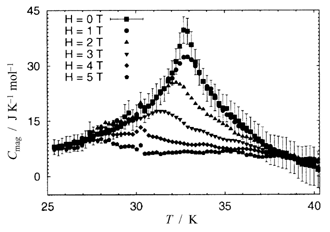
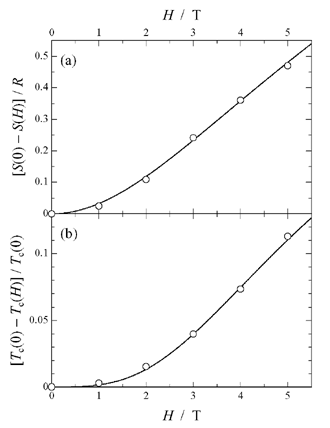
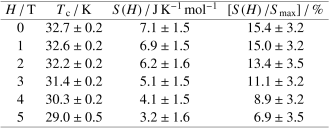
decreased. Magnetic-field dependence of the magnetic entropy and the
magnetic transition temperature is discussed by a simple model.
(by Y. Miyazaki)
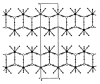
|
Fig. 1. Projection of double layer of
(tetrenH5)0.8CuII4[WV(CN)8]4·7.2H2O
on ab plane
(○: Cu,
●: W,
○: C, ●: N). The disordered
tetrenH55+
cation and H2O molecules are
omitted.
|
|
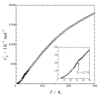
Fig. 2. Heat capacities of
(tetrenH5)0.8CuII4[WV(CN)8]4·7.2H2O
under zero magnetic field. Inset shows its heat capacities at
low temperatures. A heat capacity peak was observed
at Tc=32.7 K,
above which a heat capacity tail characteristic of
low-dimensional magnets was found.
|
|
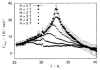
Fig. 3. Magnetic heat capacities of
(tetrenH5)0.8CuII4[WV(CN)8]4·7.2H2O
under magnetic field parallel to b
axis. As magnetic field increased, both the magnetic
transition temperature and the magnetic heat capacities
decreased.
|
|
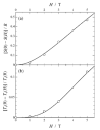
Fig. 4. Magnetic-field dependence of magnetic entropy
(a) and magnetic transition temperature (b) of
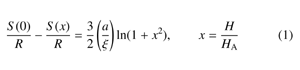
(tetrenH5)0.8CuII4[WV(CN)8]4·7.2H2O. Solid curves in (a) and (b) are drawn by
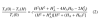
Eqs. (1) and (2), respectively.
|
|
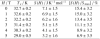
Table 1. Magnetic heat capacity parameters for
(tetrenH5)0.8CuII4[WV(CN)8]4·7.2H2O.
|

|
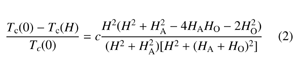
Equations (1) and (2).
|
Copyright © Research Center for Structural Thermodynamics,
Graduate School of Science, Osaka University. All rights reserved.