Thermodynamic Features of the Magnetic Ordering in Low-Dimensional Mott Insulators
We are interested in the thermodynamic features around the Néel
temperature of several organic systems consisting of BEDT-TTF
molecules and their counter ions. They are known as a kind of Mott
insulators, since one electron is localized on each dimmer consisting
of BEDT-TTF. Due to the layered structure of donors and anions, the
behavior of the 2D magnetic systems is expected. From the heat
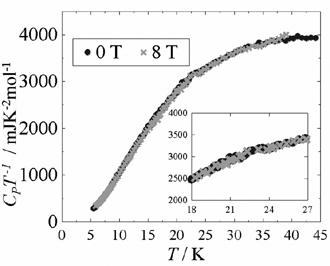
capacity measurements of
β′-(BEDT-TTF)ICl2 and
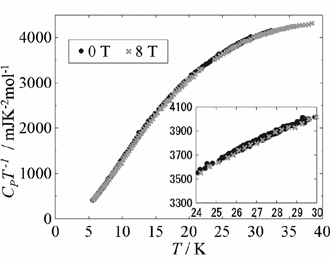
κ-(BEDT-TTF)2Cu(N(CN)2)Cl, we could not detect sharp thermal
anomalies, if the reduced entropy around the Néel temperature due to
the two-dimensional character is taken into account. It may be
reasonable to take into account the quantum character in the Mott
insulating states. The reduced entropy around the Néel temperature
seems to be the common features of Mott insulators with
low-dimensional structure. The frustration behavior of a Mott
insulating salt with triangular structure is also reported.
(by S. Yamashita & Y. Nakazawa)
|
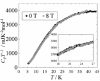
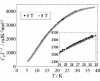
Fig. 1. Heat capacity of
β′-(BEDT-TTF)ICl2. An
anti-ferromagnetic transition is suggested at 22 K by NMR
spectra and magnetic susceptibility measurement.
|
|
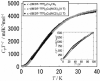
Fig. 2. Heat capacity of
κ-(BEDT-TTF)2Cu(N(CN)2)Cl.
We have failed to detect any thermal anomaly around 27 K,
at which a kind of Néel ordering is reported by NMR
experiment.
|
|
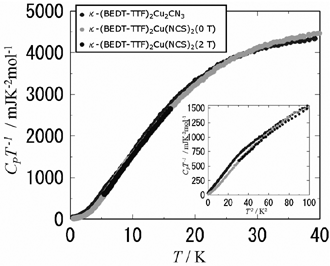
Fig. 3. Heat capacity of
κ-(BEDT-TTF)2Cu2(CN)3. The
lattice heat capacity is very similar to the
same type salt
κ-(BEDT-TTF)2Cu(NCS)2. However in the
aκ-(BEDT-TTF)2Cu2(CN)3, a broad
but reproducible thermal anomaly was detected around
5 K.
|
The Problems Related to the Residual Electron Density of States
Existing in the Superconducting State of Organic Superconductors
Focusing on the low-temperature thermodynamic properties, especially
those on the superconducting states, we have performed systematic heat
capacity measurements through the thermal relaxation calorimeters for
several κ-type salts and κ-(BEDT-TTF)2Cu[N(CN)2]Br salts of which
donor molecules are partially substituted by BEDSe-TTF. We have
observed that the electronic heat capacity coefficient γ obtained by
applying magnetic fields varies drastically even in the
superconductive phase, if one approaches gradually from the metallic
region to the Mott boundary. We also pay attention to the residual
γ*
value for these materials. This term represents the normal electron
density of states remaining in the superconducting state. The
γ*/γ
increases gradually in the region where the bulk Tc decreases
from 10 K and continues to increase with decreasing Tc, where the
Brinkmann-Rice enhancement is observable. The growth of Fermi-liquid
manner seems to give a worse influence for both Tc and the volume
fraction of superconductivity.
(by Y. Nakazawa)
|
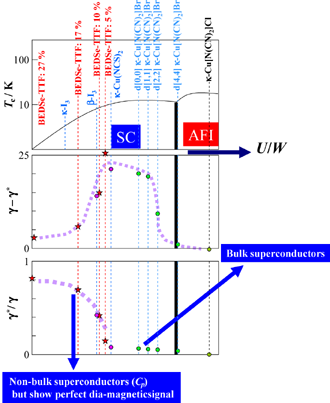
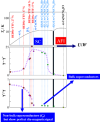
Fig. 1. The conceptual phase diagram of electronic
states of dimerized
(BEDT-TTF)2X salt. The horizontal
axis corresponding to the pressure, which effectively controls
the U/W
ratio. The behavior of the low-temperature heat-capacity
coefficient (γ
and γ*)of
κ-(BEDT-TTF)2X type organic
superconductors is also shown with the phase diagram. The
increase
of γ/γ* ratio at
the metallic region demonstrates that normal electrons are
coexisting in the superconducting phase.
|
|
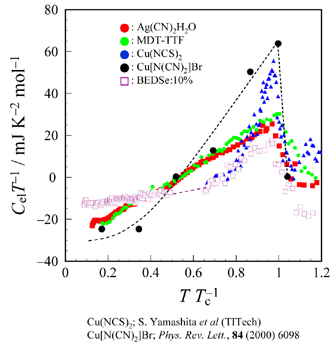
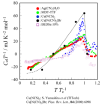
Fig. 2. The electronic heat capacity of
κ-(BEDT-TTF)2X salts. The
horizontal axis is divided
by Tc. The
shape of
the CpT–1
peak is different between 10 K class
salts and 4-5 K class salts.
|
Heat Capacities of p-type Icosahedral Quasicrystals Zn-Mg-RE (RE = Y,
Dy, Ho and Er)
Heat
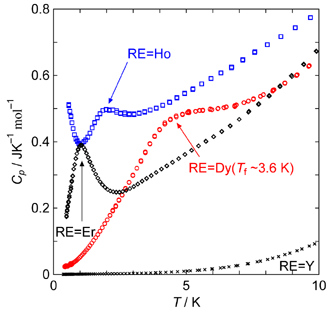
capacity Cp(T) measurements have been performed between
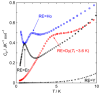
0.4 K and 300 K by relaxation method for p-type Zn-Mg-RE (RE = Y, Dy, Ho and Er)
icosahedral
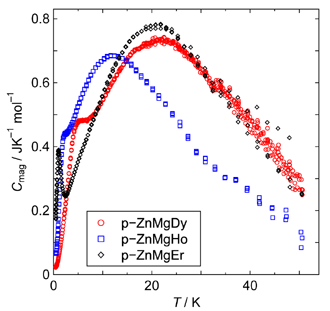
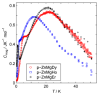
quasicrystals. The Cp(T) for the Dy, Ho and Er compounds
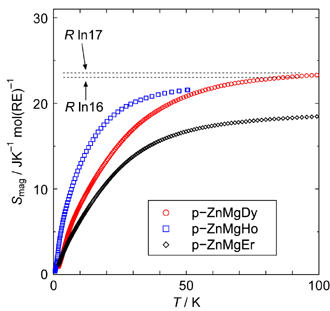
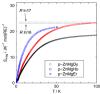
reveal large magnetic contributions below 50 K, which are estimated by
comparing a proper lattice reference, and the evolution of magnetic
entropies with temperature is analyzed.
(by H. Takakura & D. Kanki)
|
Fig. 1. Molar heat capacities of p-Zn-Mg-RE (RE = Y, Dy,
Ho and Er) measured by relaxation method.
|
|
Fig. 2. Magnetic specific heat contribution
Cmag of
p-Zn-Mg-RE (RE = Dy, Ho and Er).
|
|
Fig. 3. Magnetic
entropies Smag of
p-Zn-Mg-RE (RE = Dy, Ho and Er). The levels indicate the
entropies expected for the respective
free RE3+ ion.
|
|
|
Six-Dimensional Electron Densities of a p-type Icosahedral
Quasicrystal Zn-Mg-Ho
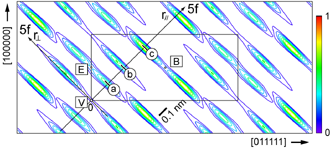
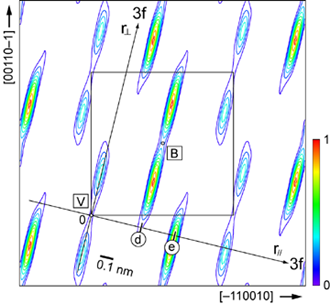
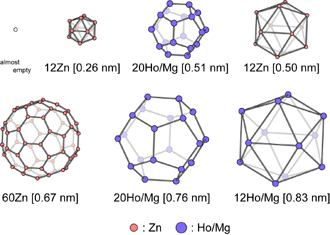
We report the phase reconstructed six-dimensional (6D) electron
densities of a p-type icosahedral quasicrystal Zn-Mg-Ho by the low
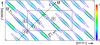
density elimination method. The densities exhibit three large
occupation domains centered at (0,0,0,0,0,0), (1,1,1,1,1,1)/2, and
(1,0,0,0,0,0)/2 in the 6D primitive unit cell. It is shown that a
Bergman-type icosahedral atomic cluster characterizes the quasicrystal
structure.
(by H. Takakura)
|
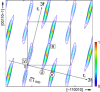
Fig. 1. 2D cut of reconstructed 6D electron densities
containing a five-fold axis in both the physical
(r∥)
and complementary
(r⊥)
space directions. The inner rectangle with thick lines
indicates the unit cell. The V: (0,0,0,0,0,0),
B:(1,1,1,1,1,1)/2, and E(1,0,0,0,0,0)/2 indicate the special
points in the unit cell. Successive icosahedral shells can be
found from the positions indicated by the letters inside
circles (a), (b), (c).
|
|
Fig. 2. 2D cut of reconstructed 6D electron densities
containing a threefold axis in both the physical
(r∥)
and complementary
(r⊥)
space directions. Successive dodecahedral shells can be found
from the positions indicated by the letters inside circles
(d), (e). The meaning of the other symbols is the same as in
Fig. 1.
|
|
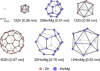
Fig. 3. Successive atom shells in ascending order that
found by the analysis of the reconstructed 6D electron
densities of the p-Zn-Mg-Ho. Atom species and atom numbers
forming each atom shell together with the radius of the shell
are given underneath each shell.
|
Copyright © Research Center for Structural Thermodynamics,
Graduate School of Science, Osaka University. All rights reserved.