Heat Capacity and
Magnetic Phase Transitions of
the Mixed-Valence Prussian Blue Complex
K0.2MnII0.66MnIII1.44 [FeII0.2FeIII0.8(CN)6]-
O0.66(CH3COO)1.32 · 7.6H2O
Heat capacities of the mixed-valence Prussian blue complex
K0.2MnII0.66MnIII1.44 [FeII0.2FeIII0.8(CN)6] O0.66(CH3COO)1.32 · 7.6H2O
were measured by adiabatic calorimetry and relaxation method under
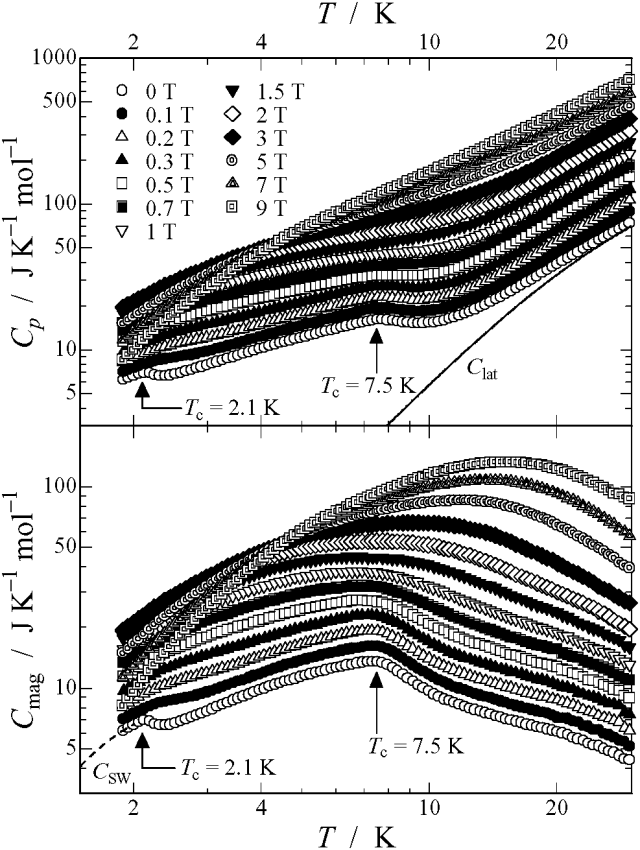
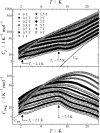
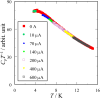
magnetic fields. Two heat capacity peaks were observed at 7.5 K and 2.1 K,
which correspond to ferri- and ferromagnetic phase transitions, respectively.
The uniaxial zero-field splitting parameter due to MnIII was estimated to be D/kB = 14.7 K. The zero-field magnetic
entropy amounted to 29.2 J K−1 mol−1, which
is close to the expected value R(0.66ln6 + 1.44ln5 +
0.2ln1 + 0.8ln2) (= 33.7 J K−1 mol−1).
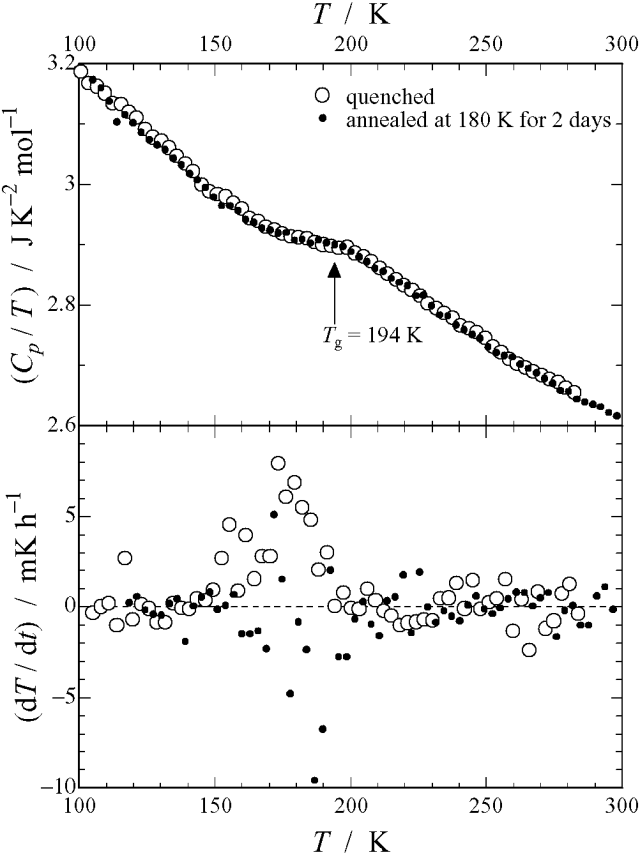
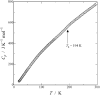
Additionally, a glass transition was found at 194 K, which is presumably due to
freezing of the orientational motion of the H2O
molecules present in the complex.
(by Y. Miyazaki)
|
Fig. 1. Heat capacity of
K0.2MnII0.66MnIII1.44 [FeII0.2FeIII0.8(CN)6] O0.66(CH3COO)1.32 · 7.6H2O
by adiabatic calorimetry.
|
|
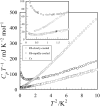
Fig. 2. Heat capacities (upper) and magnetic heat capacities (lower) of
K0.2MnII0.66MnIII1.44 [FeII0.2FeIII0.8(CN)6] O0.66(CH3COO)1.32 · 7.6H2O
under magnetic fields. Solid curve indicates the lattice heat capacity.
Broken curve shows the spin wave heat capacity with an energy gap.
|
|
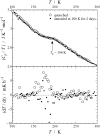
Fig. 3. Heat capacities divided by temperature (upper) and
temperature drift rates (lower) of
K0.2MnII0.66MnIII1.44 [FeII0.2FeIII0.8(CN)6] O0.66(CH3COO)1.32 · 7.6H2O.
|
Anomalous Enhancement of
Electronic Heat Capacity Coefficient of
(DI-DCNQI)2 Ag1−xCux
with One-Dimensional Structure
Thermodynamic investigation on the organic alloying system of
(DI-DCNQI)2 Ag1−xCux was performed to study the variation from the
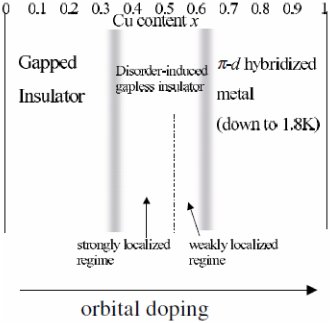
charge-ordered insulating state to the π-d hybridized metallic state.
In the metallic region between x = 0.7 and 1.0,
the coexistence of π-d hybridization and inter-site Coulomb interaction
(V) which induces localized character in the
π-electrons was found to work cooperatively. The low-temperature electronic
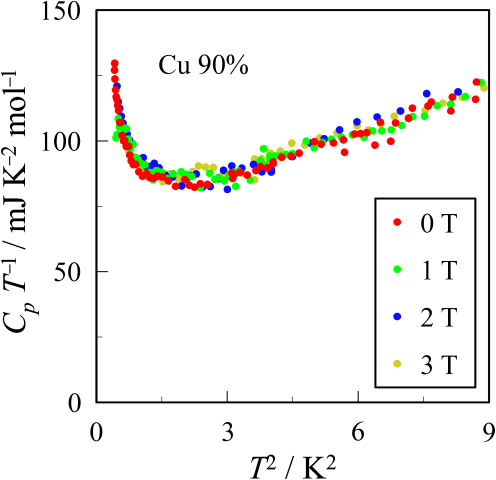
heat capacity coefficient, γ is enhanced up to
about 64 mJ K−2 mol−1 at the concentration of x
= 0.90. This value is 1.5 times the larger than the Cu 100% samples, which is
already known as the enhanced metals through magnetic susceptibility and heat
capacity measurements. The electron correlation effects in the π-electrons
plays a role to enhance the electron mass in the hybridized band.
(by Y. Nakazawa)
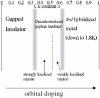
|
Fig. 1. Conceptual phase diagram of (DI-DCNQI)2 Ag1−xCux studied by Itou et al. (Synth. Met. 120, 835 (2001).)
|
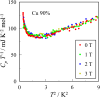
|
Fig. 2. Temperature dependence of heat capacity of (DI-DCNQI)2 Ag0.10Cu0.90 shown in a CpT −1 vs T 2 plot.
|
Heat Capacity Measurements of
θ-(BEDT-TTF)2 CsZn(SCN)4
with Applying Electric Currents
θ-(BEDT-TTF)2 CsZn(SCN)4
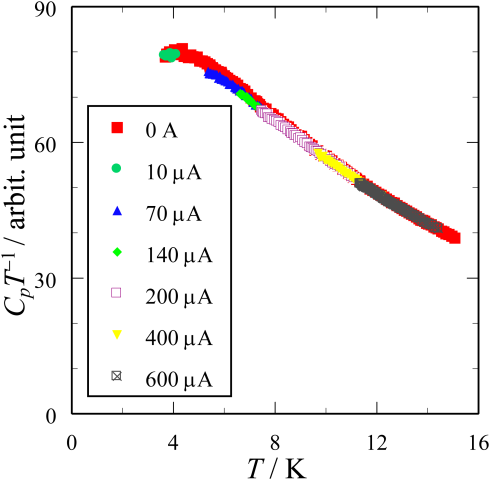
shows peculiar lattice heat capacity at low temperatures originating
from strong charge fluctuations due to strong electron correlation.
The fluctuations produce low-energy phonon modes through the
electron-phonon coupling and show a peak structure of CpT −3 around 3 K.
Since the charge fluctuation are known to be affected by the electric
fields, heat capacity measurement of
θ-(BEDT-TTF)2 CsZn(SCN)4 with
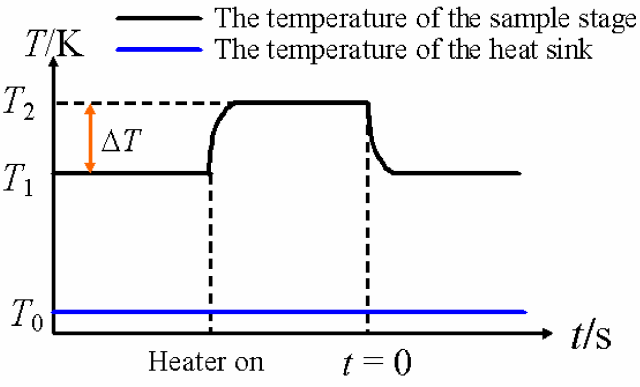
applying electric currents is performed as a steady state calorimetry.
We have introduced an analytic model to evaluate the resistance change
during the measurement process. The obtained result of
θ-(BEDT-TTF)2 CsZn(SCN)4
indicates a possibility of slight decrease of lattice heat capacity
by applying currents.
(by K. Hino & Y. Nakazawa)
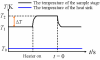
|
Fig. 1. Typical temperature profile against time in a relaxation
type measurement. T0
is the temperature of the heat sink, T1 and T2
is the temperature of sample stage in steady state.
|
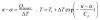
|
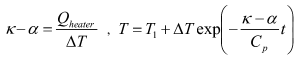
Equation.
|
|
Fig. 2. Heat capacity of θ-(BEDT-TTF)2 CsZn(SCN)4 with
applying electric currents (c axis direction).
|
Low-Temperature Heat Capacity of
Charge Transfer Salts of
BEDT-TTF with θ-Type Structure
Heat capacity measurements of θ-(BEDT-TTF)2 MZn(SCN)4 (M = Rb, Cs),
which is known as charge-ordered insulators with two-dimensional structure
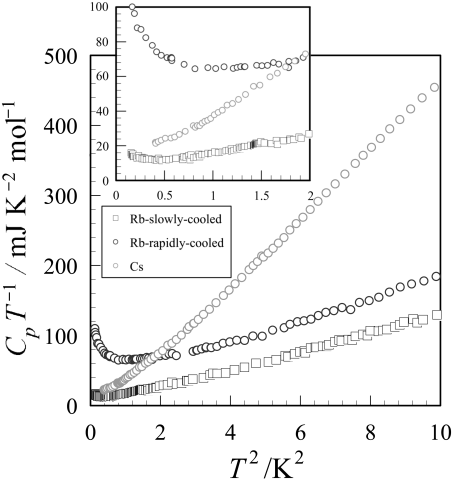
were performed by the thermal relaxation technique. The M = Rb salt shows a
characteristic behavior of disordered metals in which electrons are weakly
localized in mesoscopic domains. The electronic heat capacity coefficient
with a comparable magnitude with those of metallic systems consisting of
BEDT-TTF was detected, while that of slowly cooled sample is almost vanishing
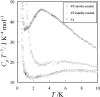
due to the opening of charge gap. In the case of M = Cs salt, the strong
charge fluctuations seem to be coupled with lattice vibrations and gives
large peak of CpT −3 around 3 K.
The electronic state of this charge fluctuated system is discussed.
(by Y. Nakazawa)
|
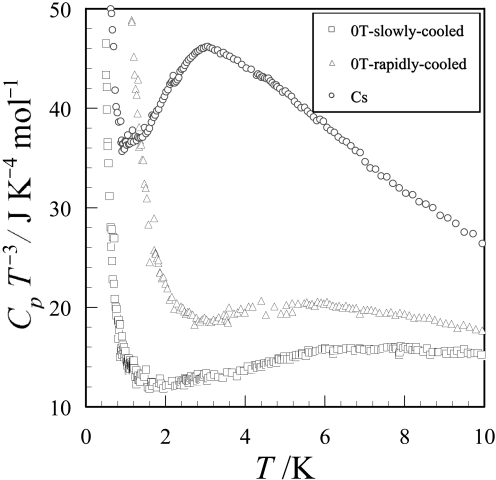
Fig. 1. CpT −1 vs T 2 plot of θ-(BEDT-TTF)2 MZn(SCN)4 (M = Rb, Cs).
The rapidly cooled M = Rb salt has a finite γ
value, while the slowly cooled M = Rb and M = Cs salts do not.
|
|
Fig. 2. CpT −3 vs T plot of θ-(BEDT-TTF)2 MZn(SCN)4 (M = Rb, Cs).
The large peak of CpT −3 is observed
around 3 K. This peak demonstrates the strong coupling of charge
fluctuations and lattice vibration.
|
Copyright © Research Center for Structural Thermodynamics,
Graduate School of Science, Osaka University. All rights reserved.