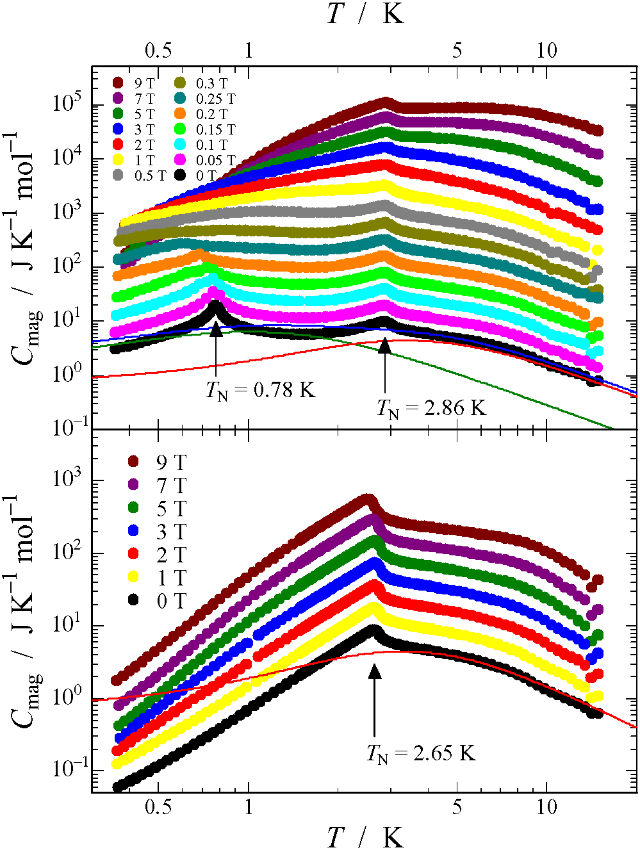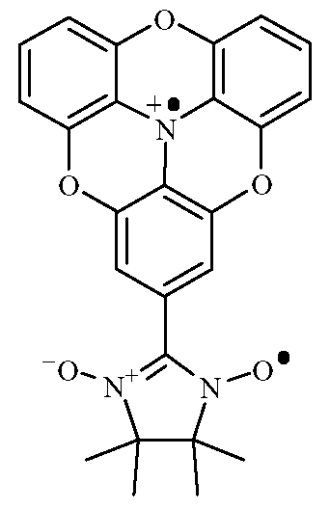
Heat capacities of 4-(nitronyl nitroxide)-2,2′:6′,2″:6″,6-trioxytriphenylamine radical cation NNTOT• + (S = 1) and MIII Cl4− (M = Fe(S = 5/2), Ga(S = 0)) salts NNTOT• + · MIII Cl4− were measured by relaxation method under magnetic fields. Two heat capacity peaks were observed at 0.78 K and 2.86 K for NNTOT• + · FeIII Cl4−, while a heat capacity peak was found at 2.65 K for NNTOT• + · GaIII Cl4−. Magnetic field dependence of these phase transitions revealed that they are all antiferromagnetic. The magnetic entropies for NNTOT• + · Fe Cl4− and NNTOT• + · Ga Cl4− amounted to 23.8 J K−1 mol−1 and 9.28 J K−1 mol−1, respectively. The former value agrees well with Rln(3×6) (= 24.0 J K−1 mol−1) for S = 5/2 and S = 1 spin systems and the latter one is close to Rln3 (= 9.13 J K−1 mol−1) for S = 1 spin systems. The zero-field magnetic heat capacity of NNTOT• + · Fe Cl4− above the higher magnetic phase transition temperature is expressed well by summation of the theoretical heat capacity curve for the high-temperature expansion of an S = 5/2 one-dimensional antiferromagnetic Heisenberg model with the intrachain magnetic interaction J/kB = −0.18 K and that of an S = 1 one-dimensional antiferromagnetic Heisenberg model with the intrachain magnetic interaction J/kB = −1.9 K. On the other hand, the zero-field magnetic heat capacity of NNTOT• + · Ga Cl4− above the magnetic phase transition temperature is expressed well by the theoretical heat capacity curve for the high-temperature expansion of an S = 1 one-dimensional antiferromagnetic Heisenberg model with the intrachain magnetic interaction J/kB = −1.9 K.