Development of a Heat Capacity Measurement Technique
with Applying Electric Currents and Its Application to
a Strongly Correlated Electron System
θ-(BEDT-TTF)2 CsZn(SCN)4
We have tried to develop a thermodynamic measurement technique
with applying electric currents to investigate electron-phonon interaction in
θ-(BEDT-TTF)2 CsZn(SCN)4
which belong to strongly correlated electrons systems. Since
θ-(BEDT-TTF)2 CsZn(SCN)4
is reported to exhibit peculiar lattice heat capacity characterized by
the Boson peak owing to the electron-phonon interaction at low temperatures,
it is interesting to trace how the suppression of the fluctuations
by applied electric currents (electric fields) manifest itself
in the temperature dependence of the heat capacity. We have confirmed that
the thermal gradient in the sample stage is negligible in the measurement.
Taking the change of
κ − α
against temperatures into account, we have succeeded to improve reliability
of the measurement. As a consequence, the heat capacity of
θ-(BEDT-TTF)2 CsZn(SCN)4
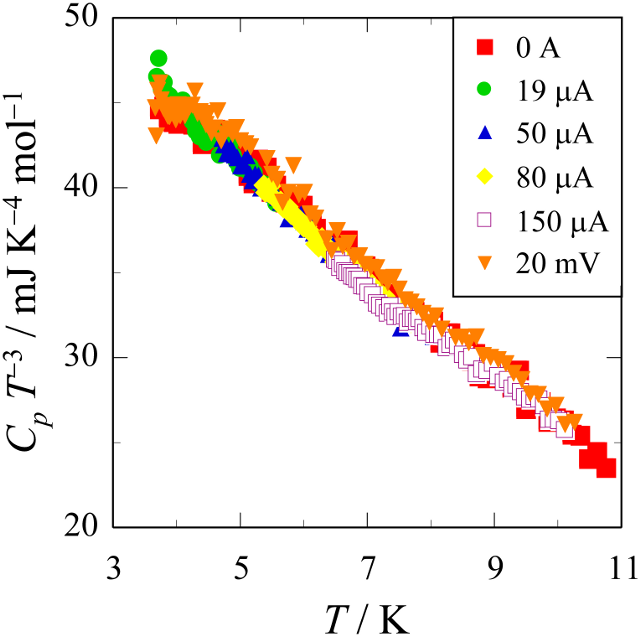
do not show any systematic change by the electric fields up to about
100 m V cm−1.
(by K. Hino & Y. Nakazawa)
|
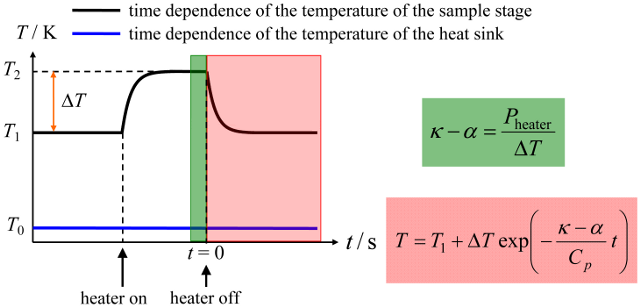
Fig. 1.
Typical temperature profile against time in the thermal relaxation
measurement. T0 is
the temperature of the heat sink,
T1 and
T2 are
the temperatures of sample stage in two steady state.
|
|
Fig. 2.
Heat capacity of
θ-(BEDT-TTF)2 CsZn(SCN)4
with applying electric currents
(c axis direction).
|
Copyright © Research Center for Structural Thermodynamics,
Graduate School of Science, Osaka University. All rights reserved.