Heat Capacity Measurement
near Phase Transition Point
with Relaxation Calorimeter

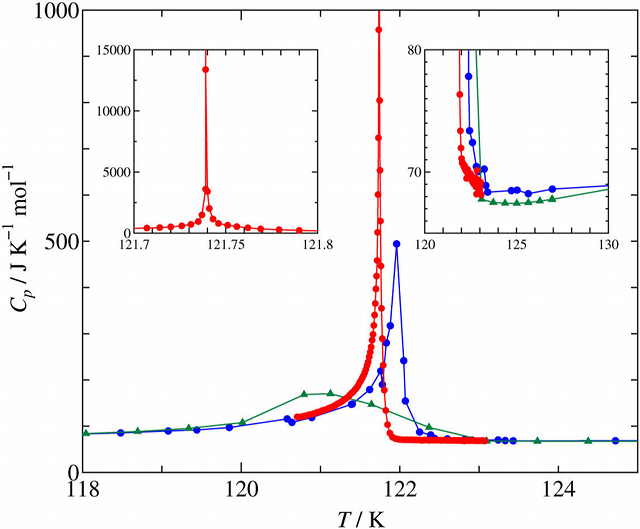
While relaxation calorimetry can not be applied to detect the first-order phase transition, some possibility is discussed by using a relaxation calorimeter (PPMS). The method proposed here is to analyze all the temperature data during one scan to reproduce the heat capacity. We applied this method to the heat capacity measurement of KH2PO4 near the ferroelectric transition at Tc = 122 K and obtained an extremely sharp transition. We also tried the measurement on BaTiO3 near the first-order transitions at Tc = 203 K. However, the result was not quite as expected.

(by H. Suzuki & A. Inaba)

Fig. 1

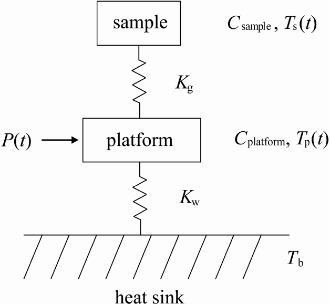
Fig. 1. Schematic diagram of the relaxation calorimeter (PPMS). Tp, Ts, and Tb stand for the temperatures of platform, sample, and heat sink, respectively. Kw and Kg are the thermal conductivities of wire and sample, respectively. P is the input heating power to the sample and platform.

Equation

Equation.

Fig. 2

Fig. 2. Molar heat capacity of KH2PO4 near the phase transition point obtained by three different methods: adiabatic calorimetry (blue marks), relaxation method by PPMS (green marks), and scanning method by PPMS (red marks).

Copyright © Research Center for Structural Thermodynamics, Graduate School of Science, Osaka University. All rights reserved.