Coordination Chemistry Laboratory, Department of Chemistry, Graduate School of Science, The University of Osaka


Design and Development of Conceptually Novel Ionic Solids with New Functionalities via Coordination Molecular Technology
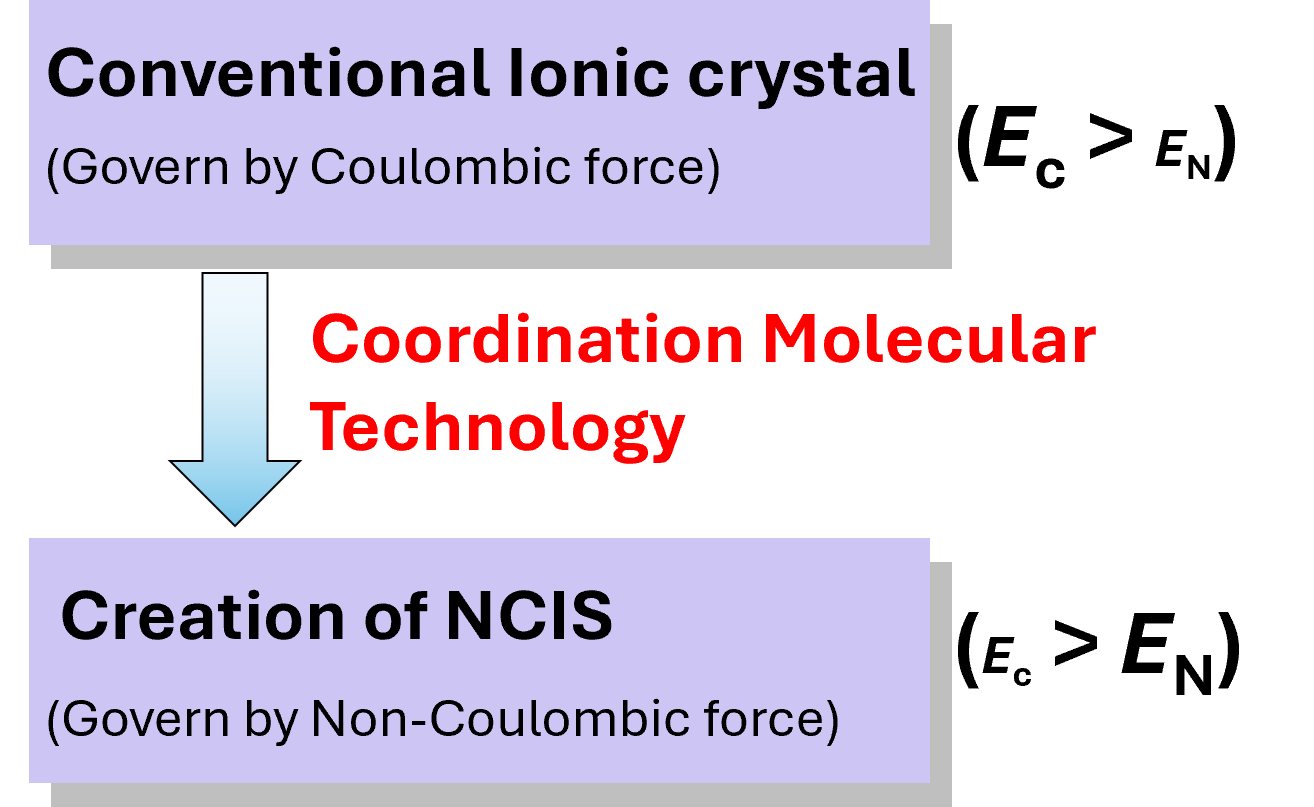 Ionic solids composed of cationic and anionic species are ubiquitous in nature and are widely utilized as functional materials. In general, the spatial arrangement of cations and anions is strictly governed by Coulombic interactions and while non-Coulombic interactions play a lesser role. Thus, cations and anions are typically arranged alternately in a dense manner to maximise the Coulombic attraction. However, if the non-Coulombic interactions are greater than the Coulombic interactions, a new class of conceptual ionic solids referred by us as Non-Coulombic Ionic Solids (NCIS) can be realized. These materials are expected to exhibit unprecedented properties that are not observed in conventional ionic solids.
In our research group, we explore the synthesis of NCIS through a metal complex-based aprroach termed Coordination Molecular Technology. As illustrated in the figure below, through the design of a hexanuclear AuI4CoIII2 cationic complex bearing both hydrophobic and hydrophilic ligands, with perchlorate ions as the counter anions, we succesfully created an ionic crystal with a "charge separated structure" in which cations and anions aggregate independently. In this compound, non-Coulombic interactions (C-H···π & H-bonding) play a crucial role in directing the crystal structure, making it a representative example of NCIS.
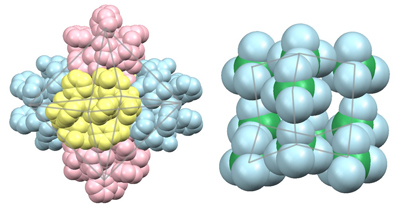
Hexamer of AuI4CoIII2 complex-cations (left) and decamer of 10 ClO4- anions (right)
This research project is supported by JST CREST